
Hegseth Softens China Rhetoric at Shangri-La Dialogue, But Warns Against Indo-Pacific Dominance

Hegseth Softens China Rhetoric at Shangri-La Dialogue, But Warns Against Indo-Pacific Dominance
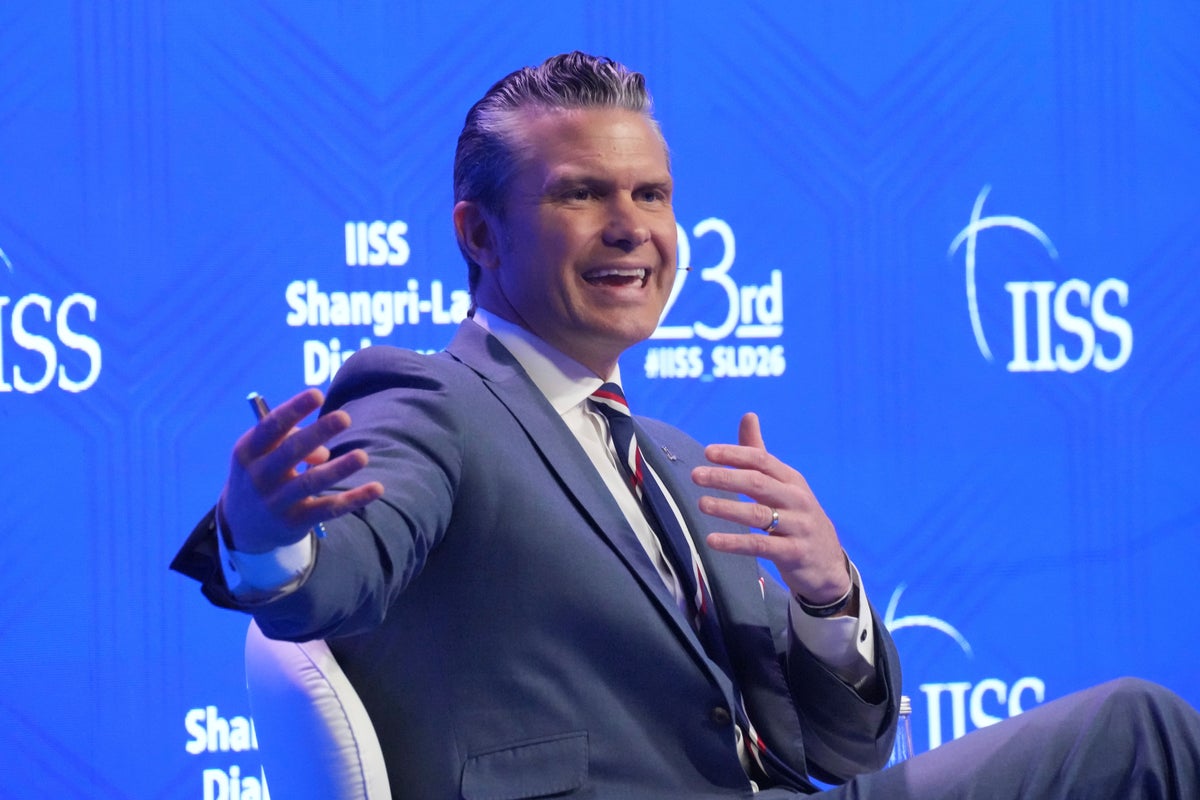
U.S. Defense Secretary Pete Hegseth struck a notably more measured tone on China at Singapore’s Shangri-La Dialogue on Saturday, walking back last year’s pointed warnings of imminent threat while reaffirming Washington’s commitment to Pacific security — a shift that drew immediate criticism from within his own government’s congressional delegation.
A Diplomatic Reset, With Caveats
Addressing world leaders, diplomats, and senior security officials at the annual defense forum, Hegseth described the Indo-Pacific as carrying “profound implications for U.S. security and prosperity,” with Washington’s stated priority being to “achieve a lasting and favorable balance of power in the Pacific.”
The rhetorical recalibration is significant. At the same forum last year, Hegseth warned that China was not merely building military capacity to take Taiwan — it was “actively training for it, every day.” No such language appeared in this year’s address.
The shift comes roughly two weeks after U.S. President Donald Trump visited Chinese President Xi Jinping in Beijing, after which Trump described Xi as a “great leader” and predicted a “fantastic future together” between the two nations.
Constructive Stability — With Limits
Hegseth, who accompanied Trump to Beijing, said both leaders had agreed that the two countries should “build a constructive relationship of strategic stability, based on fairness and reciprocity.” He acknowledged that national interests would sometimes diverge but insisted “practical, mutually beneficial agreements” remained achievable.
Yet he drew a firm line on regional hegemony. “There is rightful alarm regarding China’s historic military buildup and the expansion of its military activities in the region and beyond,” he said, adding that “a Pacific dominated by any hegemon would unravel the regional balance of power.”
Taiwan: “No Change in Status” — But Arms Deal Left Open
Hegseth told the forum there was “no change in our status” toward Taiwan, but declined to comment on a pending $14 billion arms package that Trump has yet to approve — and has publicly floated as a “very good negotiating chip” with Beijing.
China claims Taiwan as its own territory and has not ruled out the use of force. The U.S. is legally obligated to help Taiwan maintain its self-defence capabilities, though it maintains a policy of “strategic ambiguity” on direct military intervention. Hegseth deferred entirely to the president on the arms question: “Any decision about future Taiwan arms sales, as the president said, will rest with him.”
Democratic Senator Raises the Alarm
The softer posture did not go unchallenged. U.S. Senator Tammy Duckworth, an Illinois Democrat attending as part of a congressional delegation, accused the Trump administration of “cozying up” to China and diverting strategic focus.
“I worry that this administration is being distracted into wars that they’ve started in other parts of the world at the expense of our commitment here in the Indo-Pacific,” Duckworth told reporters on the sidelines. “I am concerned that it seems like our president is entering into policies where he’s doing what Beijing wants him to do.”
Allies Praised for Defence Spending; Europe Quietly Rebuked
Hegseth used the platform to press Washington’s longstanding demand that allies shoulder greater defence burdens, declaring that the U.S. needs “partners, not protectorates.” He singled out several Asian nations for praise while delivering an implicit rebuke to European allies — unnamed — whom he accused of getting “distracted by empty globalist rhetoric about the rules-based international order.”
“Our partners in Asia have long understood that the bedrock of a durable partnership is not based on idealistic values but on the concrete alignment of national interests,” he said, adding pointedly: “I think Western Europe might take note.”
Hegseth made no mention of Ukraine or Iran in his prepared remarks. When pressed on Iran, he said only that Trump had assured him any concluded deal with Tehran “will be a good deal.”
Australia Pushes Back on Rules-Based Order Dismissal
Australian Defence Minister Richard Marles, whose country was among those Hegseth commended for increased military spending, offered a direct counterpoint. Speaking immediately after the U.S. secretary, Marles argued that the international rules-based order required renovation — not abandonment.
“When the rules apply, smaller states have agency,” Marles said. “When the rules yield to power, sovereignty becomes the purview of the powerful — and no state in this room today, whatever its size, is well served by that outcome.”