

Smart Glasses, Surveillance, and the Legal Grey Zone: Singapore Police Investigate Alleged Trailing of Female Students

A Viral Incident That Exposes the Limits of Existing Law
Singapore police are investigating a video circulated on social media that shows a man wearing smart glasses allegedly trailing female students near Marymount MRT station, and the case raises a question that goes well beyond one individual’s behaviour: when wearable technology enables covert recording in public spaces, does Singapore’s legal and regulatory architecture have the tools to respond adequately? The incident, which surfaced on the Instagram account Singapore Parents on Tuesday before an earlier Reddit post was taken down by the platform, has provoked public outrage — but the outrage itself points to a structural gap that the authorities have yet to fully close.
What the Video Shows, and What It Implies
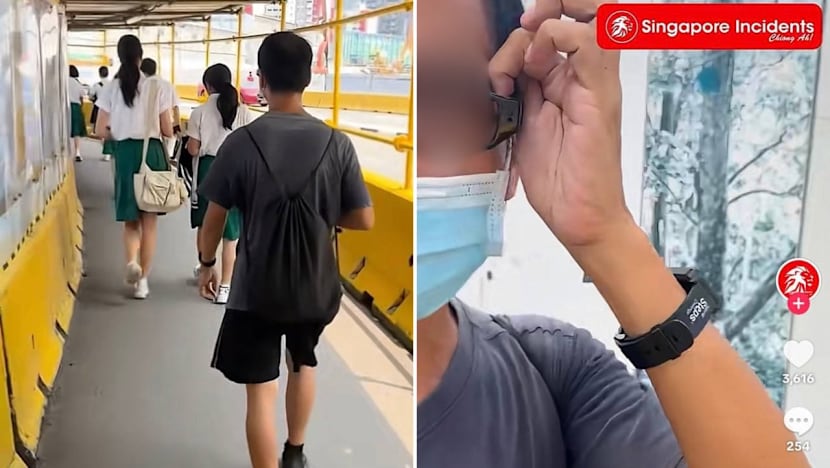
The footage depicts a man in a dark T-shirt and black shorts walking in close proximity behind students in uniforms that appear to match those of Raffles Institution, one of Singapore’s most prominent secondary schools. He holds his mobile phone close to his chest, and at one point is seen pressing the frame of his black-rimmed glasses — a gesture consistent with activating a recording function on smart eyewear. When he appears to register that he is himself being filmed, he reverses direction and walks away. The pedestrian walkway leading towards Marymount MRT station is the reported location. A police spokesperson confirmed to CNA on Wednesday, 23 September, that a report had been lodged and that investigations are ongoing, though no arrest or charge has been publicly announced.
The Instagram account that amplified the video described the glasses as smart or artificial intelligence-enabled eyewear capable of recording video, and framed the concern not merely around the device itself but around the combination of the technology and the man’s sustained, close proximity to the students. That framing is legally significant. Singapore’s Films Act and its Penal Code provisions on voyeurism, tightened under the 2019 amendments, target the recording of private parts or intimate acts without consent — but they were not designed with the ambient, always-on recording capacity of wearable AI in mind.
The Regulatory Architecture and Its Blind Spots
Singapore has invested considerable effort in updating its legal framework around technology-facilitated harassment and voyeurism. The Protection from Harassment Act, the Criminal Procedure Code amendments, and the 2019 Penal Code revisions collectively represent a serious legislative attempt to address digital-era misconduct. Yet the scenario captured in this video inhabits an uncomfortable middle ground: if no intimate image was recorded, if the footage shows only students walking in a public space, the legal threshold for criminal liability becomes genuinely difficult to establish. The man’s behaviour — trailing minors, pressing the frame of recording glasses — may constitute harassment or cause alarm under POHA, but prosecutors would need to demonstrate intent and effect, neither of which is straightforward to prove from a bystander’s video alone.
This is not a uniquely Singaporean problem, but Singapore’s institutional context makes it particularly pointed. The city-state’s governance model has historically excelled at anticipatory regulation — the Personal Data Protection Act, the Cybersecurity Act, and the more recent Online Safety Act all reflect a state that prefers to legislate ahead of harms rather than react to them. Smart glasses capable of seamless, inconspicuous video recording have been commercially available in various forms since at least 2013, and AI-enhanced versions have proliferated rapidly in recent years. The absence of a clear, technology-specific framework governing their use in public spaces, particularly in proximity to minors, is a notable omission in an otherwise dense regulatory landscape.
Institutional Trust, Minors, and the Stakes of Inaction
The involvement of students from an institution like Raffles Institution — a school whose alumni network intersects deeply with Singapore’s professional and political elite — ensures that this incident will not be quietly forgotten. CNA has reached out to the school to determine whether students or parents have raised concerns directly with the institution, though no response had been published at the time of writing. The social amplification of the video, first through Reddit and then through Instagram before the Reddit post was removed, illustrates how quickly public anxiety around surveillance and the safety of minors can outpace the formal response mechanisms of both platforms and law enforcement.
What this case ultimately demands is not merely a successful investigation of one individual, but a broader policy conversation about how Singapore regulates the use of wearable recording technology in sensitive public environments — near schools, near transport nodes, near spaces where minors congregate. The state’s capacity for institutional sophistication is not in doubt; what remains to be seen is whether the political will exists to move from reactive policing to anticipatory rule-setting in a domain where the technology is advancing faster than the statute books. The man in the smart glasses may or may not face charges. The regulatory gap he has exposed, however, will persist regardless of the outcome of this particular investigation.