
Singapore’s Outdoor Workers Bear the Heaviest Cost When the Haze Rolls In

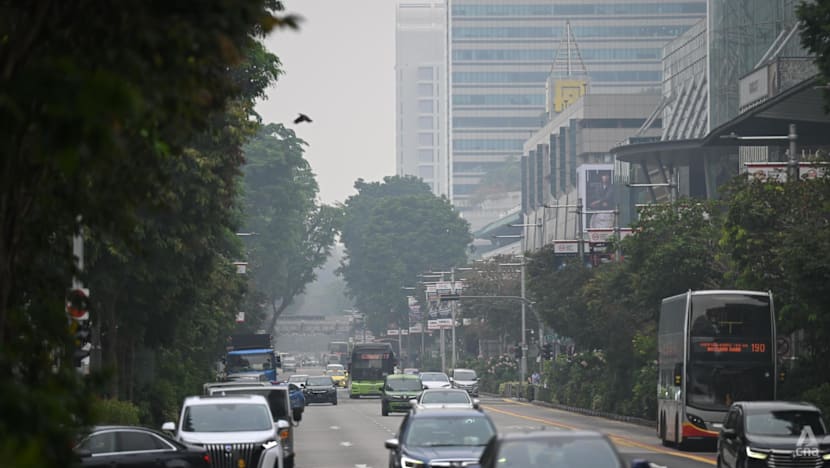
When the haze descended on Singapore with enough force to push air quality into the very unhealthy range, the road construction crews did not stop. Food delivery riders continued to wait in traffic. The city kept moving, even as the air that sustained it turned grey and acrid.
That tension — between the imperative to earn and the imperative to breathe — sits at the heart of a structural problem that Singapore has yet to fully resolve, one that becomes acute each time Sumatra’s fires send smoke drifting across the Strait of Malacca.
A Familiar Season, A Persistent Asymmetry
The haze is not new to Singapore. Neither is the recognition that its costs fall unevenly. Those with office jobs retreated indoors, ordered food through an app, and let the algorithm dispatch someone else into the particulate air. Platform workers delivering that food, construction crews finishing their pours, cleaners and security guards at their posts — they had no equivalent refuge.
What makes this asymmetry more than a matter of individual misfortune is the financial architecture that reinforces it. As Olivia Jensen, Deputy Director and Lead Scientist at the National University of Singapore’s Institute for the Public Understanding of Risk, has argued, the financial pressures facing outdoor workers make reducing their exposure genuinely difficult. The choice between health and livelihood is not a free one when income depends on hours logged outdoors.
Acting Minister for Manpower Jasmin Lau stated on Friday, October 16, that protecting workers from haze is “not optional” for employers. The Ministry of Manpower indicated it would issue further guidance on how employers could use one-hour PM2.5 readings to inform decisions, including the possibility of pausing outdoor work for vulnerable workers. The signal was clear enough; the implementation details remained, as ever, the harder part.
Delivery Riders and the Limits of the PSI
Among outdoor workers, delivery riders occupy a particularly exposed position. Their work places them in heavy traffic for extended periods, which means their air quality exposure is not adequately captured by Singapore’s standard 24-hour Pollutant Standards Index (PSI) or headline PM2.5 figures. Haze compounds an already chronic burden: vehicle emissions carry nitrogen dioxide and carbon monoxide, and generate secondary pollutants including ozone — none of which the PSI alone reflects with sufficient granularity for someone sitting on a motorcycle at a busy intersection during lunch hour.
Under the Platform Workers Act, platform operators bear legal responsibility for the health and safety of their workers and are obliged to advise them on haze protection. Grab and Foodpanda have distributed N95 masks to workers. That is a meaningful step, and not a trivial one logistically. But it addresses the symptom more than the information gap that underlies it.
Without localised air quality data at high-exposure locations — busy intersections, delivery pick-up points outside hawker centres and commercial blocks — riders cannot make genuinely informed decisions about when to take additional precautions. The aggregate city-wide reading tells them something; it does not tell them what they are breathing at the corner of Orchard Road and Scotts at noon.
What Better Monitoring Would Actually Require
Jensen’s analysis points toward a practical intervention that sits within institutional reach: extending air quality monitoring to the locations where exposure is highest, and making that data publicly accessible in near real time. Crucially, she argues that measurements should cover all components of the PSI, not PM2.5 alone, to give a complete picture of what outdoor workers actually inhale during a haze episode.
This is not a technically exotic proposal. Distributed low-cost sensor networks have been deployed in comparable cities. The question is whether Singapore’s regulatory and public health institutions treat the gap as urgent enough to close before the next haze season, rather than after it.
In the immediate term, properly fitted N95 masks remain the most accessible layer of protection for workers who cannot reduce their outdoor exposure. They are hot, uncomfortable, and imperfect — but they do substantially reduce inhalation of fine particles when outdoor work cannot be paused. Platform operators and construction companies can accelerate distribution and actively encourage use, rather than treating mask provision as a compliance checkbox.
The Structural Question That Outlasts Each Haze Episode
Masks and ministerial statements address the acute moment. They do not resolve the underlying dynamic: that Singapore’s essential outdoor workforce absorbs environmental risks that the rest of the city largely externalises onto them, and that the financial structures of platform work make voluntary protective behaviour economically costly for the individual worker.
Each haze season tests whether the institutional frameworks built around worker protection — the Platform Workers Act, MOM’s advisory powers, operators’ duty of care — translate into meaningful protection on the ground, or whether they remain, in practice, guidance that workers navigate alone. The answer, so far, is somewhere uncomfortable in between.