
Singapore at Ten Years of SGSecure: Are We Psychologically Ready for a Terror Attack?

A Close Shave
The words were clinical and deliberate: “It’s the moment that you have all been waiting for. The people I will be killing.” They appeared in a 21-page manifesto authored by a self-radicalised 14-year-old who had been planning a mass-casualty stabbing attack at his secondary school. Weeks before the intended strike, the Internal Security Department arrested him. Authorities described it as a “close shave” — a phrase that carries a particular weight in a city-state that has, for decades, maintained an almost studied distance from large-scale political violence.
That arrest, made in May of this year, arrived during a significant institutional milestone. 2025 marks the tenth year of SGSecure, Singapore’s national community movement against terrorism. The anniversary invites a harder question than the programme’s promotional materials tend to ask: beyond drills, apps, and awareness campaigns, are Singaporeans genuinely psychologically prepared to respond when — not if — an attack occurs?
What Psychological Preparedness Actually Means
Most people, when asked about terror attacks, reach instinctively for the language of fear. But the psychologists working within Singapore’s Home Team frame the problem differently. Jasmine Tan, Assistant Director of the Home Team Psychology Division under the Ministry of Home Affairs, draws a deliberate distinction between fear as a passive state and preparedness as an active capacity.
“When we talk about our psychological preparedness, ultimately what we really want to do is we want to move beyond the fear,” Tan told CNA. “We want to translate it into people being able to take action.”
That translation operates across two dimensions. The cognitive dimension requires citizens to understand what a terror attack looks like in practice — not as an abstraction drawn from overseas news footage, but as a scenario they have mentally rehearsed. This means familiarity with reporting channels, evacuation procedures, and the practical steps available to a bystander in a crisis. The emotional dimension is equally important: it equips people to maintain composure rather than freeze, to administer first aid rather than flee in panic.
Dr Diong Siew Maan, Director of the Home Team Psychology Division, argues that the communal framing of this preparation is not incidental — it is structurally significant. “When it’s not done alone, it’s less fearful also. And when it’s done repeatedly, the fear actually goes down.” The mechanism she describes is well-established in psychological literature: repeated exposure to a feared stimulus, within a controlled and socially supported context, reduces the acute stress response over time.
Psychological First Aid as Infrastructure
One of the more concrete initiatives to emerge from this framework is the formal training of community members in psychological first aid — what Dr Diong describes, with deliberate accessibility, as “almost like an emotional band-aid.” The concept recognises a structural reality: in the immediate aftermath of a mass-casualty event, there will never be enough licensed psychologists and counsellors to attend to everyone affected.
“If everybody has that skill in the community, then they can help one another,” Dr Diong said. “It’s like a life skill.” The framing is deliberate: by positioning psychological first aid alongside CPR or basic firefighting as a civic competency rather than a clinical specialisation, the programme attempts to normalise preparedness as something ordinary people do, not something they delegate to professionals.
This logic extends to the Home Team’s own officers. First responders are not immune to the psychological toll of unexpected trauma — a colleague injured in the field, a scene involving children or vulnerable individuals. Dr Diong noted that supervisors are trained to monitor their teams during operations, conducting check-ins when something appears off, and referring officers to embedded psychologists when necessary.
What SGSecure Is, and What It Does
SGSecure launched in 2016 as Singapore’s primary institutional vehicle for community-level counter-terrorism resilience. Its operational logic rests on three interlocking commitments: staying alert to detect and survive an attack; staying united to support one another across ethnic and religious lines both before and after an incident; and staying strong to preserve the social fabric that a terrorist attack is, by design, intended to fracture.
The programme’s infrastructure includes a mobile application through which users can submit reports of suspicious activity, receive emergency alerts, and register as community responders. Those who hold certifications in CPR, first aid, basic firefighting, or psychological first aid can enrol to receive proximity-based alerts about cardiac arrests or minor fires in their vicinity — an extension of the responder model into everyday emergencies, not just terrorism scenarios.
The Vigilance Gap: What the Experiments Revealed
In June 2025, the Ministry of Home Affairs conducted two social experiments designed to stress-test public vigilance. The results were instructive, and somewhat uncomfortable.
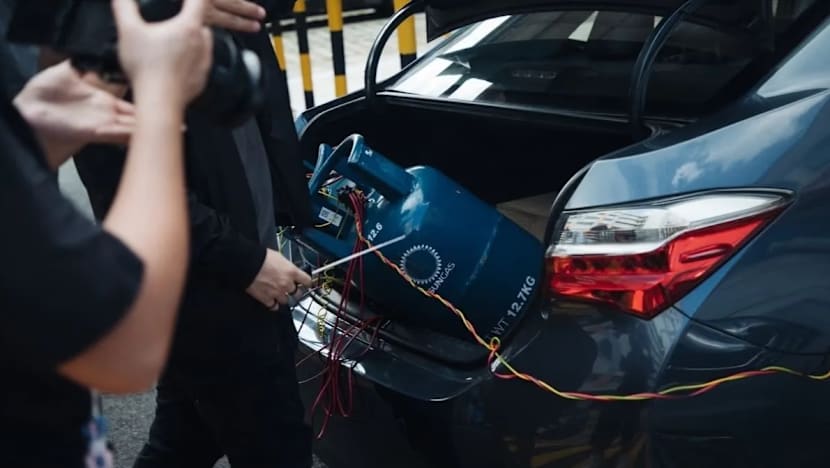
In the first experiment, a man dressed in a manner described as suspicious left a suitcase — fitted with protruding wires and, in a second iteration, a blinking red light — near a car park and ATM at Our Tampines Hub during peak hours. The second experiment placed a car loaded with empty gas cylinders at a car park beside Bishan Community Club. The cylinders were eventually repositioned to protrude visibly from the boot, with smoke emitting periodically from the vehicle.
Of the 2,530 individuals who walked past the suspicious objects across both experiments, only 17.3 per cent noticed them at all. Of those who did notice, just 5.9 per cent — 26 people in total — took any steps to alert the authorities. The rest walked away.
The figures are striking, but the interpretation requires care. Dr Diong resists the most cynical reading. “I think a lot of Singaporeans still care,” she said. “There have been a lot of occasions when, when there’s a call for help, Singaporeans will come forward. It is about giving the right information, the right time, and then people will step up.” Distraction, busyness, and the ambient noise of urban life account for some of the non-response. But the data also points to something more structurally interesting.
Jasmine Tan identifies the phenomenon as an intention-action gap — a well-documented psychological dynamic in which awareness of the correct behaviour does not automatically produce that behaviour.
“This gap in the intention and action is useful because then it guides us to know exactly what we need to do, perhaps to prompt people to take more action,” Tan said. The framing is analytically sound: understanding why the gap exists is a precondition for designing interventions that close it.
The Misinformation Problem
A separate challenge compounds the vigilance gap: the speed at which misinformation and rumour travel through digital networks during a crisis. Dr Diong noted that unverified information frequently reaches the public before official channels can respond, forcing Home Team officers to manage not only the physical emergency but also the information environment surrounding it.
The psychological consequences of this dynamic extend well beyond the immediate scene. “People who are reading the news will also be affected,” Dr Diong observed. “Which means that the help is no longer just confined to those who are affected by the incident, but those who have heard about the incident and are indirectly being influenced as a result.” The implication is significant: post-incident psychological support cannot be scoped only to direct victims. It must be designed at population scale, accounting for the diffuse anxiety that a high-profile attack generates across an entire connected society.
Inside the ISD: Rehabilitation and the Limits of Assumption
The psychologists who work within the Internal Security Department operate under conditions that require anonymity. The two interviewed for this piece are identified here only by the pseudonyms Dave and Cass.
Dave, who has spent five years at ISD, recalls an early case that fundamentally recalibrated his professional assumptions. He had expected a radicalised individual to present in ways that were visibly extreme — in speech, in manner, in affect. What he encountered instead was a young person who seemed, in almost every observable respect, entirely ordinary.
“Their speech, behaviour, and mannerisms were familiar, because it felt like it almost mirrored my younger self,” Dave said. The encounter forced a reckoning with the limits of profiling as a conceptual tool. Radicalisation, he concluded, is not reliably legible from the outside. Its markers can be subtle, internal, and invisible to casual observation — which makes both early detection and effective rehabilitation substantially more complex than a checklist approach would suggest.
That complexity shapes Dave’s approach to rehabilitation under the Internal Security Act. Each case demands a holistic account of the individual — their motivations, their vulnerabilities, the specific circumstances that made a violent ideology legible or appealing to them. From that account, a tailored rehabilitation plan is constructed. The goal is not simply behavioural compliance but a genuine reorientation of the thoughts, feelings, and identity frameworks that made radicalisation possible in the first place.
“Most importantly, it made me believe that these individuals deserve a second chance,” Dave said. “Despite the harm they may have caused or the ideologies they may have espoused in the past, I came to understand that they are still human beings capable of growth, change, and redemption.”
Cass, who has worked at ISD for a decade in research, counselling, and psychological risk assessment related to violent extremism, describes a case from 2022 that has stayed with her. The young person she refers to as “Daniel” was among the first she worked with. What struck her was not the severity of his prior radicalisation but the degree and pace of his transformation.
“Despite the personal challenges he faced, he demonstrated a remarkable capacity for resilience and growth,” Cass said. “Through our work together, I witnessed him blossom into a confident and capable individual, excelling in his academics and socially, and finding direction in life.” The case reinforced what the psychological literature on trauma and recovery consistently finds: the conditions of the therapeutic environment — whether it is supportive, non-judgmental, and structured around the individual’s own agency — are as consequential as any specific intervention technique.
Calibrating Fear Without Inducing Panic
ISD’s most recent threat assessment, released this week, reaffirmed that the terrorism threat to Singapore remains high. Ongoing conflicts in the Middle East continue to elevate the global threat environment, and Singapore — as a prosperous, symbolically significant, and internationally connected city-state — remains an attractive target.
Against that backdrop, the question of how to prepare a population psychologically without tipping into counterproductive panic is not merely rhetorical. Jasmine Tan’s answer is precise: balance is the operative principle, and fear itself is not the enemy.
“Fear can be a good thing because if there’s no fear then people will not feel that there is a need to do anything, so there needs to be a certain level of fear,” she said. The objective is not to eliminate anxiety but to channel it — to transform a diffuse, paralysing dread into a focused, action-oriented awareness. “How to do it without unnecessarily causing fear? It needs a very balanced approach, and I would say a lot of it is mental preparation, preparing people for the possibility that this may happen.”
Ten years into SGSecure, that balance remains a work in progress. The arrest of a 14-year-old with a 21-page manifesto is a reminder that the threat does not wait for programmes to mature. What the past decade has built — in community training, institutional psychology, and rehabilitation infrastructure — is a foundation. Whether it is sufficient will not be known until it is tested in ways that no social experiment can fully simulate.