

China’s Overcapacity Problem Is Forcing Unlikely Allies to the Same Table

In October, fourteen economies signed a US-led joint statement calling for coordinated action against industrial overcapacity. The document named no country explicitly. But no one needed it to. China’s manufacturing dominance has long been the shared, unspoken concern binding otherwise fractious trading partners together — and this statement may mark the moment that shared anxiety began translating into something more structured.
To understand why that matters, it helps to go back to 2001. China’s entry into the World Trade Organization unleashed a wave of cheap manufactured exports that hollowed out domestic industries across the United States, Europe and parts of Asia. Economists later termed this the “China Shock.” At the time, as former US trade negotiator Kellie Meiman Hock observed, key trading partners were simply unwilling to forgo access to the Chinese market or to bend WTO rules to address what was already a building threat.
The appetite for collective resistance did not exist. China’s industrial rise accelerated anyway.
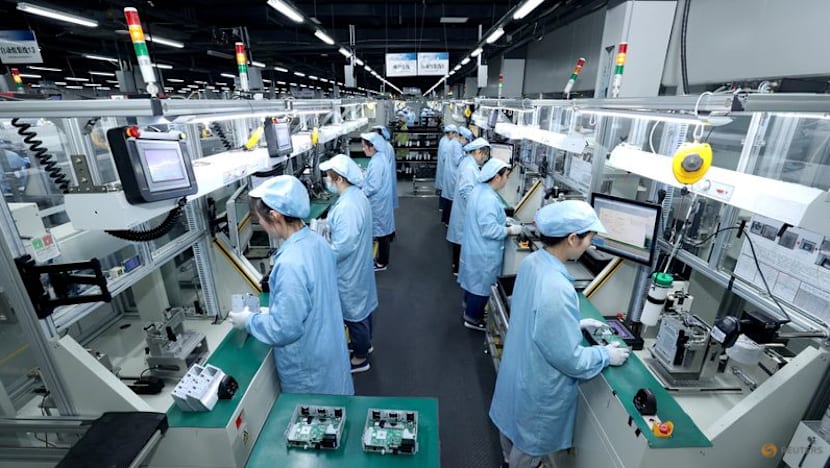
By 2015, Beijing had formalised its ambitions through Made in China 2025, an initiative designed to dominate high-tech global sectors and reduce Chinese dependence on foreign technology. Industrial subsidies, low-cost capital and preferential policy access did precisely what they were designed to do. China now leads in electric vehicles, batteries, solar panels, foundational semiconductors and chemicals — the five sectors the October joint statement specifically targets for examination.
The problem is structural. Domestic Chinese demand cannot absorb this volume of output, so China exports aggressively, raising sustained concerns about dumping. Chinese-manufactured vehicles accounted for roughly one in five battery-electric cars sold in the European Union in 2025, with nearly half of those being Chinese brands. The EU is particularly exposed because the United States has already restricted Chinese imports in these categories, effectively redirecting the export surge elsewhere.
Weeks before the joint statement emerged, the US had launched Section 301 investigations in March into what it described as structural excess capacity across foreign manufacturing sectors. Fifteen economies fell under that scrutiny, including Singapore, India, Japan, South Korea, Mexico and the EU. The irony was not subtle: five of those same investigated economies went on to co-sign the US-led statement against the very problem Washington accused them of enabling.
There is no real contradiction in that position, even if it looks paradoxical. These governments have their own reasons to fear Chinese export pressure on their domestic manufacturers, reasons entirely independent of whether they accept Washington’s allegations against themselves. As Deborah Elms, Head of Trade at the Hinrich Foundation, noted, the Trump administration’s trade posture has shifted toward what she calls “executive-driven, coercive unilateralism.” Yet even within that framework, the administration has recognised that confronting China’s industrial capacity alone is less effective than doing so with partners.
The signatories have agreed to establish platforms examining excess capacity across those five sectors and committed to technical discussions on coordinated defensive measures. That is more than collective hand-wringing, though the Brookings Institution’s phrase captures well what such multilateral statements often amount to. This one is non-binding. Its significance lies in the direction it signals, not the obligations it imposes.
Former Singapore diplomat Bilahari Kausikan put the structural reality plainly: middle powers have more agency on trade than on national security or artificial intelligence, but that agency remains limited. The United States, whatever its current posture, remains indispensable as a counterweight to China. Canadian Prime Minister Mark Carney framed it differently in Davos in January — “if we’re not at the table, we’re on the menu” — but the underlying logic is the same. Coordination among middle powers matters. Coordination with the US matters more.
Barbara Weisel of the Carnegie Endowment for International Peace identified the specific friction points ahead. The Section 301 investigation on structural overcapacity complicates any US claim to partnership. So does China’s well-documented capacity to exploit divisions among trading partners, offering bilateral incentives to discourage collective action. Beijing has done this before. It will do it again.
None of this means the joint statement dissolves Trump’s tariff pressure on its co-signatories. It does not. The Section 301 investigation into Singapore and others remains open, and the Trump administration’s appetite for using tariffs as leverage is structurally unchanged. The joint statement on overcapacity and the bilateral trade pressure operate on parallel tracks, and Washington shows no sign of merging them.
What the statement does reveal is a shared recognition that China Shock 2.0 — the low-carbon economy version, driven by subsidised electric vehicles, batteries and solar technology — poses a more immediate threat to these economies than the friction of being simultaneously investigated by Washington. Middle powers may aspire to a rules-based trading order that does not depend on either great power. But when Chinese export capacity threatens their domestic manufacturers, the US remains the most effective partner they have.



