
China’s Summer of Extremes: A Faster-Warming Nation Confronts Its Climate Present

In the underground stations of Chengdu’s metro system, sections of platform have been cordoned off — not for construction, not for safety drills, but for commuters to lie down and breathe. The photographs circulating on Xiaohongshu tell a quiet story: people stretched out on cool tiles, escaping temperatures above 37 degrees Celsius outside. It is an improvised solution to a structural problem, and it is playing out across one of the world’s largest and fastest-warming nations.
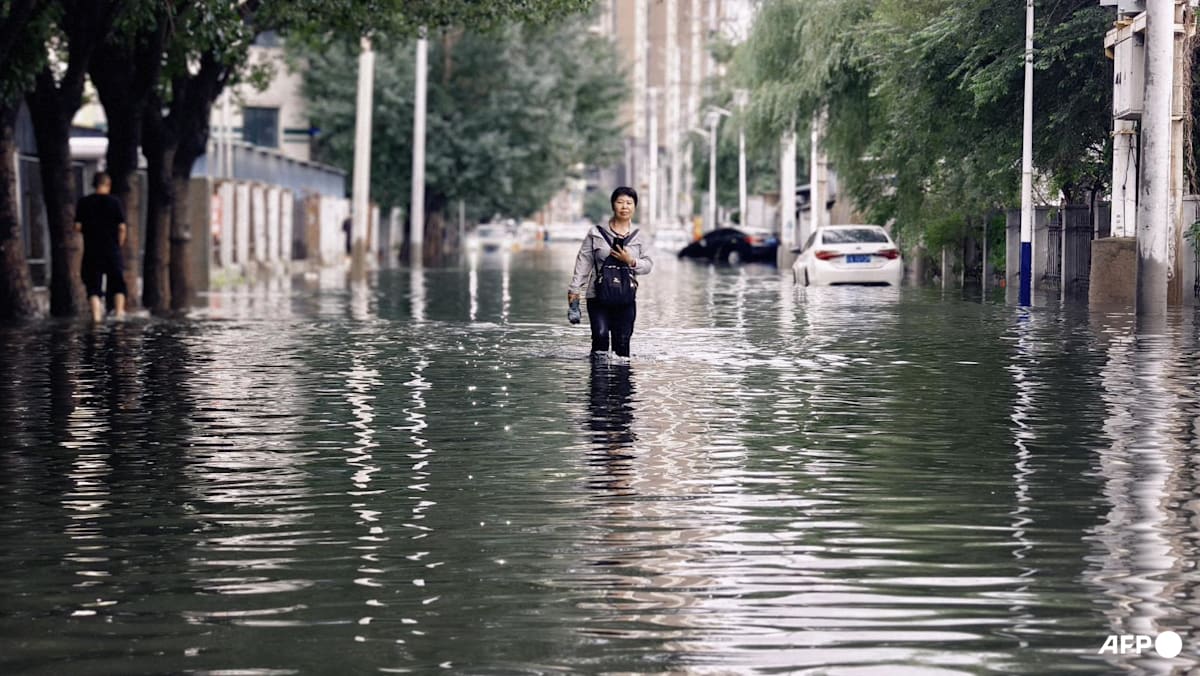
China has absorbed a relentless sequence of climate shocks in recent weeks. Twin tornadoes tore through central Hubei province on July 6, killing at least 11 people and injuring hundreds. Typhoon Maysak struck Hainan before sweeping into Guangxi, leaving at least 39 dead as of July 9. Torrential rains forced more than 260,000 people to evacuate their homes. A landslide triggered by heavy rain in Chongqing on July 17 killed eight people, with 34 still missing. Rivers in Guangxi’s Baise rose between one and three metres within 24 hours. Rail authorities suspended passenger services on the Shanghai-Kunming line. In Hubei, a 30-year-old man was swept from his apartment by tornado-force winds. “It was all over in three to five minutes,” one resident said, “but it dealt a catastrophic blow.”
These are not isolated events. They are data points in a trend that scientists have been tracking with increasing urgency.
According to the China Meteorological Administration’s annual Blue Book on Climate Change, released on July 2, China’s average annual temperature increased by 0.31 degrees Celsius per decade between 1961 and 2025 — a rate that exceeds the global average over the same period. The country’s average temperature in 2025 already ranks among the two warmest years since nationwide records began in 1901. Northern China is warming faster than the south; the west is warming faster than the east. The geography of heat is uneven, but the direction is uniform.
Professor Benjamin Horton, dean of the School of Energy and Environment at the City University of Hong Kong, points to a structural explanation. “Land warms faster than oceans,” he says. “Because China is a large continental landmass, it experiences stronger warming than the global average.” The implication is not merely meteorological. “The concern is no longer simply that summers are hotter,” Horton adds. “The climate baseline itself is shifting so quickly that extremes once considered rare are becoming normal.”
The heat data reinforces this. Shanghai registered 37 degrees Celsius on July 15. Parts of northwestern China are expected to reach 44 degrees. Chengdu faces highs of 37 to 38 degrees this week. China issued its first national-level heat health risk warning of the year on July 14. In Shenzhen, emergency services responded to nearly 40 heat-related calls between July 1 and July 12 alone — including 19 heatstroke cases on a single day, July 11. The Shenzhen Emergency Medical Centre issued warnings via WeChat, advising residents to avoid outdoor activities including hiking.
Adaptation is already underway, and it takes unexpected forms. A residential complex in Shanxi province installed a high-pressure misting sprinkler system across all eight of its buildings in 2024 — over 200 atomising nozzles per building — capable of reducing surface temperatures by five to eight degrees within minutes. It operates throughout summer months. In Chengdu, metro platforms become rest stops. These are functional responses to a heat emergency, but they are also symptoms of how deeply the problem has embedded itself into daily infrastructure.
Horton identifies urbanisation as a compounding factor. “Rapid expansion of cities, concrete surfaces, and reduced vegetation make urban areas substantially hotter than surrounding rural regions, especially during heatwaves,” he says. The urban heat island effect is not new science, but its consequences are intensifying as China’s cities continue to expand and the regional climate warms simultaneously.
Emissions, Pledges, and the Gap Between Them
China remains the world’s largest annual emitter of greenhouse gases, a position it has held since overtaking the United States in 2006. Its heavy reliance on coal — still central to energy security and industrial output — sits in tension with the climate commitments President Xi Jinping has articulated on the international stage. Speaking at the United Nations last September, Xi announced plans to reduce greenhouse gas emissions by seven to ten per cent below peak levels by 2035, reaffirming the country’s dual goals of reaching peak carbon dioxide emissions by 2030 and achieving carbon neutrality by 2060. He also pledged to increase wind and solar capacity and raise the share of non-fossil fuels in domestic energy consumption to over 30 per cent.
The ambition is not in question. The pace is. “China deserves credit for making substantial progress on its climate pledges,” Horton says, “but progress is real, and so is the magnitude of ongoing emissions.” He frames the central test plainly: ultimate success will depend on “how quickly renewable expansion translates into sustained reductions in absolute emissions.” Improvements to building efficiency, urban design — cooling centres, green roofs, urban forests, reflective materials — would also help manage rising temperatures at the city level, he adds.
In 2025, 11 of the 27 typhoons that formed over the northwest Pacific and South China Sea made landfall in China, according to the CMA. The number is striking. It suggests that the extreme weather battering Chinese cities and provinces this summer is not an aberration to be waited out, but a condition to be managed — now, and in every summer that follows.
“China is no longer confronting a future climate problem,” Horton says. “It is managing a present-day climate problem.” Somewhere in a Chengdu metro station, a commuter lying on a cool platform tile already knows this to be true.