
Malaysia’s Myanmar Engagement Tests ASEAN’s Unity and the Limits of Its Peace Roadmap

As ASEAN member states quietly normalise contact with Myanmar’s military leader Min Aung Hlaing, the bloc’s collective position on the country’s reintegration is facing its most sustained stress test since the 2021 coup — and Malaysia’s recent outreach has brought that tension into sharp relief.
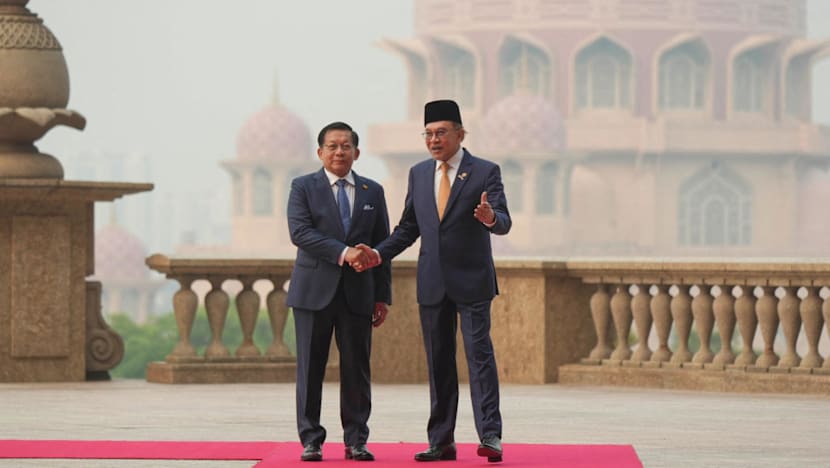
The immediate development is significant. On October 8, Malaysian Prime Minister Anwar Ibrahim hosted Min Aung Hlaing in Putrajaya and said Kuala Lumpur would do “whatever is possible” to help bring Myanmar back into the ASEAN fold. Malaysia insists that the visit does not amount to formal recognition of the military-backed government, but the distinction is becoming increasingly difficult to sustain politically when the optics include an official visit, bilateral cooperation, economic discussions and a red-carpet reception.
Malaysia is not acting in isolation. Since Min Aung Hlaing assumed the presidency in April 2026, he has already been hosted by Thailand, Cambodia, Vietnam, Laos and now Malaysia. That makes Kuala Lumpur the fifth ASEAN capital to receive him in a matter of months. The cumulative effect matters far more than any single meeting. Each bilateral encounter can be defended as pragmatic diplomacy; taken together, they begin to look like a gradual restoration of regional legitimacy.
This is precisely why the current moment matters for ASEAN as an institution.
The bloc’s official framework has not formally changed. The Five-Point Consensus, agreed in April 2021, remains its stated roadmap for addressing the Myanmar crisis. It calls for an immediate cessation of violence, constructive dialogue among all parties, mediation by a special ASEAN envoy, humanitarian assistance and access for that envoy to meet the relevant stakeholders. Myanmar’s senior political representatives have consequently remained excluded from ASEAN’s highest-level meetings because the bloc has repeatedly concluded that there has been insufficient progress in implementing those commitments.
As recently as October 2025, ASEAN leaders again expressed “deep concern” over the continuing conflict and humanitarian crisis and explicitly noted the lack of substantive progress on the Five-Point Consensus. They reaffirmed that any durable settlement should restore peace, stability and democracy through an inclusive, Myanmar-led political process.
On paper, therefore, ASEAN’s position remains coherent.
In practice, however, the gap between the collective position and the behaviour of individual member states is widening.
That is the real issue.
ASEAN has always allowed substantial room for bilateral diplomacy. Member states have different relationships with Myanmar, different economic interests and different security concerns. Thailand shares a long border. Malaysia hosts large numbers of Myanmar nationals, including Rohingya refugees. Vietnam, Laos and Cambodia each approach Naypyidaw through their own strategic calculations.
The existence of bilateral engagement is therefore not new.
What is changing is its intensity, visibility and political symbolism.
When senior military leaders were largely excluded from high-profile regional diplomacy after the coup, ASEAN’s restrictions carried symbolic weight even when enforcement was imperfect. The message was that Myanmar remained an ASEAN member, but its military leadership could not enjoy business-as-usual treatment while ignoring the bloc’s own peace framework.
That leverage becomes weaker every time individual capitals restore precisely that business-as-usual treatment.
Malaysia’s position illustrates the contradiction particularly clearly.
Anwar has presented the engagement as pragmatic. Kuala Lumpur has major practical concerns involving the repatriation of Myanmar nationals and has already returned more than 10,000 people this year. Malaysia also argues that direct communication with Naypyidaw is necessary if it is to address refugee flows, bilateral trade and humanitarian issues.
Those are real policy concerns.
But diplomacy is never only about the substance discussed behind closed doors. It is also about status, access and imagery.
A state visit carries meaning.
A handshake at the prime minister’s office carries meaning.
A red carpet carries meaning.
And for a government that has spent years trying to escape international isolation, those symbols are valuable diplomatic assets.
Moe Thuzar of Singapore’s ISEAS-Yusof Ishak Institute captured that asymmetry particularly well when she observed that Naypyidaw would “milk any diplomatic mileage it can get” from the Malaysian visit. She noted that Myanmar’s leadership has long relied heavily on bilateral relationships to advance its interests and that Min Aung Hlaing’s recent foreign trips have frequently included business delegations and investment-focused discussions.
The asymmetry is important.
For ASEAN governments, engagement is often described as a means to obtain something: cooperation on migration, access for humanitarian assistance, reduced violence, political dialogue or compliance with the Five-Point Consensus.
For Naypyidaw, however, the benefits arrive immediately.
A meeting itself produces photographs.
An official invitation produces legitimacy.
Commercial talks demonstrate that economic isolation is easing.
A succession of visits to ASEAN capitals suggests that regional ostracism is ending.
The concessions expected in return are much harder to identify.
That raises the central analytical problem: what exactly is ASEAN receiving in exchange for normalisation?
If increased engagement resulted in measurable progress — reduced violence, access for humanitarian organisations, meaningful dialogue with opposition groups or implementation of the Five-Point Consensus — then a pragmatic case could be made that isolation had failed and conditional engagement was producing better results.
But the evidence for such a trade-off remains limited.
ASEAN’s own assessments have repeatedly acknowledged the absence of substantial progress on the consensus. Violence has continued, the country remains fragmented by conflict and political dialogue involving all major stakeholders remains elusive.
This is why the distinction between engagement and compliance is becoming so important.
Dialogue in itself is not necessarily a concession. Governments routinely speak to actors they distrust or oppose because diplomacy requires communication. ASEAN cannot realistically contribute to a political settlement in Myanmar without maintaining channels to the authorities in Naypyidaw.
But engagement becomes politically costly when it is detached from conditions.
If the military leadership gains greater diplomatic recognition regardless of whether it fulfils any of ASEAN’s demands, the incentive structure changes. Compliance becomes less valuable because reintegration begins to occur anyway.
In that scenario, the Five-Point Consensus remains formally alive while becoming progressively less relevant in practice.
That is the risk now confronting ASEAN.
The bloc’s institutional power has always depended heavily on consensus rather than enforcement. It has no supranational authority comparable to the European Union and generally relies on political pressure, diplomatic isolation and negotiated compromise rather than sanctions imposed collectively.
That makes unity particularly important.
If some members insist that Myanmar must demonstrate progress before normalisation while others restore high-level relations independently, Naypyidaw can simply work around the collective framework by cultivating individual governments.
The result is a classic divide-and-engage strategy.
Myanmar does not need ASEAN to formally abandon the Five-Point Consensus. It only needs enough member states to behave as if the restrictions no longer matter.
The pressure this creates inside the bloc is already visible.
Analysts have pointed to countries such as the Philippines, Singapore and Indonesia as being more cautious about premature normalisation. Philippine Foreign Secretary Teresa Lazaro has continued to describe the Five-Point Consensus as ASEAN’s preferred framework, while Singapore is expected to maintain a similar emphasis when it assumes the ASEAN chairmanship in 2027.
That means ASEAN could increasingly find itself operating on two tracks.
On the institutional track, the bloc maintains the Five-Point Consensus, limits Myanmar’s participation in top-level meetings and continues to call for dialogue and an end to violence.
On the bilateral track, individual members steadily expand official contact, trade relations and political recognition.
Both approaches can coexist for a time.
The question is whether they can coexist indefinitely without making the collective policy meaningless.
Malaysia’s case makes that tension even sharper because Kuala Lumpur was itself one of the more active proponents of engagement with multiple Myanmar stakeholders during its 2025 ASEAN chairmanship. Malaysian officials held contacts not only with the military authorities but also emphasised engagement with other actors, including opposition forces.
Analysts such as Thuzar have argued that any renewed dialogue must retain that balance and continue involving organisations such as the National Unity Government rather than allowing relations with Naypyidaw to become the sole channel of diplomacy.
That distinction may determine whether the current shift represents a genuine diplomatic strategy or simple rehabilitation.
Structured engagement would require benchmarks.
For example, ASEAN could link additional diplomatic privileges to specific actions: humanitarian access, measurable reductions in violence, engagement with opposition actors or cooperation with the ASEAN special envoy.
Under such a model, increased contact would become an instrument of leverage.
Without those conditions, the sequence is reversed.
Myanmar receives progressively greater diplomatic access first and is then asked to demonstrate compliance afterwards.
That is a far weaker negotiating position.
There is also a broader credibility problem for ASEAN.
The Five-Point Consensus was never particularly strong as an enforcement mechanism. Its importance rested largely on the fact that all ASEAN members had endorsed it and continued to present it as the common regional framework.
If member states now begin treating the document as optional in their bilateral relations, other governments in the region will inevitably notice.
The issue therefore extends beyond Myanmar.
ASEAN frequently presents itself as the central diplomatic institution of Southeast Asia. Its influence rests on the assumption that ten — now eleven with Timor-Leste’s accession — very different states can still establish common rules and defend them collectively.
Myanmar is testing that proposition.
The military leadership has strong incentives to encourage fragmentation because bilateral diplomacy is fundamentally easier to navigate than a united ASEAN position. One government may prioritise refugees. Another may prioritise border stability. Another may prioritise trade or investment.
Each relationship can therefore be negotiated separately.
From Naypyidaw’s perspective, this is far preferable to satisfying a regional framework that requires broader political concessions.
The strategic question for ASEAN is consequently not whether it should talk to Myanmar.
It almost certainly must.
The real question is whether those conversations are tied to a coherent collective strategy.
If ASEAN can use renewed access to extract tangible progress on humanitarian assistance, political dialogue and violence reduction, then the present diplomatic opening could eventually strengthen rather than weaken the Five-Point Consensus.
If not, the opposite dynamic becomes more likely.
The Five-Point Consensus will continue to exist in communiqués while bilateral normalisation gradually overtakes it in reality.
That would leave ASEAN with an uncomfortable outcome: a peace framework that was never formally abandoned, but which ceased to determine how its own members behave.
Malaysia’s outreach therefore matters far beyond the bilateral relationship between Kuala Lumpur and Naypyidaw.
It is a test of whether ASEAN can distinguish communication from recognition, engagement from rehabilitation and diplomacy from concession.
Min Aung Hlaing’s government appears to understand those distinctions very clearly.
For ASEAN, the harder task is proving that it does too.