
Xi Jinping Visits Pyongyang to Consolidate Beijing’s Indo-Pacific Alliances

Xi Jinping Visits Pyongyang to Consolidate Beijing’s Indo-Pacific Alliances
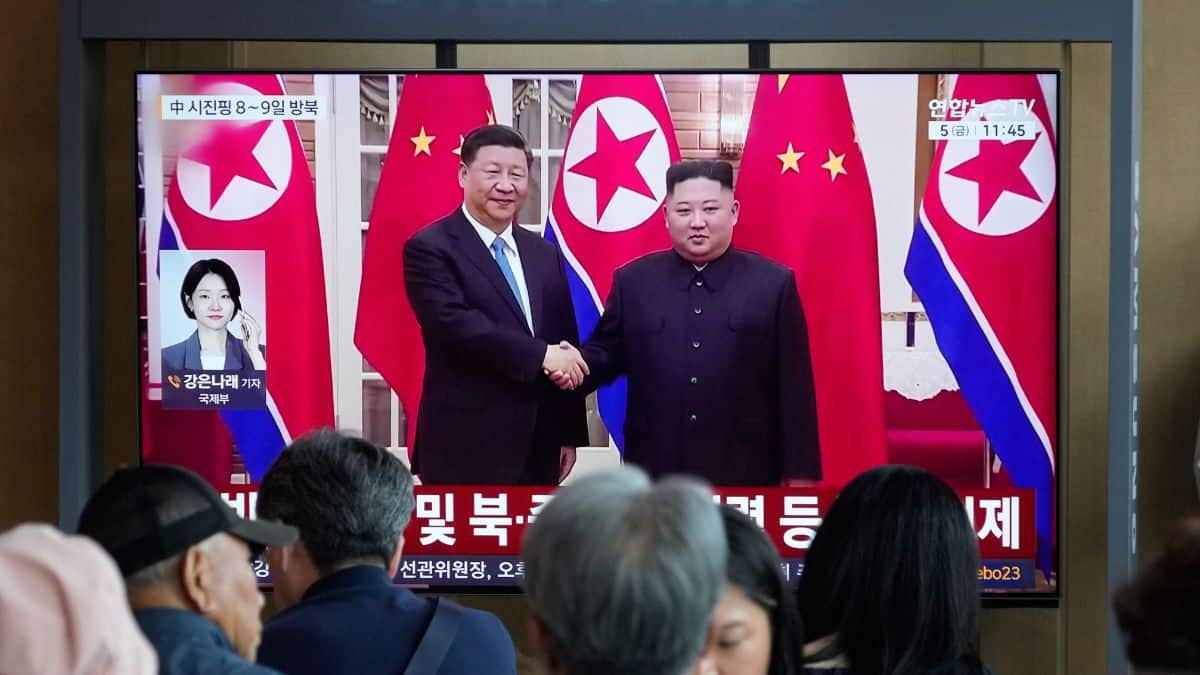
Chinese President Xi Jinping has arrived in Pyongyang for a two-day state visit — his first trip to North Korea in seven years — calling for deeper “strategic coordination and cooperation” with Kim Jong Un as Beijing moves to tighten its network of regional partnerships across the Indo-Pacific.
A Choreographed Welcome in Pyongyang
Kim Jong Un and first lady Ri Sol Ju received Xi and his wife Peng Liyuan at the airport, with North Korean children presenting bouquets as Xi’s plane landed. At Kim Il Sung Square, a mounted cavalry escort and carefully choreographed crowds waving flowers and flags beneath oversized portraits of both leaders marked the formal welcome ceremony.
Following a 21-gun salute, the two leaders reviewed an honor guard whose members shouted in Korean: “We wish Comrade Xi Jinping good health.” Talks and a state banquet at Mokran House followed.
Beijing’s Strategic Calculus
Xi’s Pyongyang visit is the third major diplomatic move in rapid succession. Weeks earlier, Xi hosted Russian President Vladimir Putin and US President Donald Trump in Beijing — two visits that signalled China’s intent to position itself at the centre of competing geopolitical currents.
The North Korea leg of this diplomatic offensive carries a specific strategic logic. Beijing seeks to reassert its primacy as Pyongyang’s most critical economic and diplomatic partner, at a moment when Russia-North Korea ties have deepened substantially — driven by military cooperation linked to the war in Ukraine.
For North Korea, Xi’s visit represents another move in its own balancing act: extracting military and economic benefits from both Moscow and Beijing while avoiding over-dependence on either.
Nuclear Provocations Frame the Visit
The diplomatic pageantry arrives against a backdrop of escalating North Korean nuclear signalling. The day before Xi landed, North Korean state media reported that Kim had inspected a major munitions facility and received briefings on “expanding the capacity to produce various ballistic and cruise missiles.”
Last week, Kim visited a new plant manufacturing weapons-grade nuclear material, declaring that Pyongyang intends to “beef up our state’s nuclear forces at an exponential rate.” Whether North Korea’s illegal nuclear programme will feature directly in Xi-Kim discussions remains unclear.
The Korean Peninsula in a Wider Regional Frame
The Korean peninsula was among issues discussed when Trump visited Beijing in May. Trump has repeatedly expressed interest in resuming high-level diplomacy with Kim — he met the North Korean leader three times during his first term in an ultimately stalled bid to dismantle Pyongyang’s nuclear programme.
Kim signalled last autumn that he would consider meeting Trump again, but only if Washington abandoned denuclearisation as a precondition — a position that leaves little room for near-term diplomatic progress.
Analysts note that North Korea’s strategic value to Beijing extends beyond bilateral ties. A nuclear-armed, unpredictable Pyongyang forces South Korea and Japan to prioritise homeland defence over regional power projection — a structural constraint that serves Chinese interests without requiring Beijing to fire a single shot.
Xi’s Pyongyang visit, read alongside his recent engagements with Putin and Trump, underscores Beijing’s broader intent: to consolidate a network of strategic partnerships that keeps China indispensable across an increasingly fractured Indo-Pacific order.