
Beijing Hails Trump-Xi Summit as Historic Turning Point, But Analysts Warn of Veiled Threats

Beijing Hails Trump-Xi Summit as Historic Turning Point, But Analysts Warn of Veiled Threats
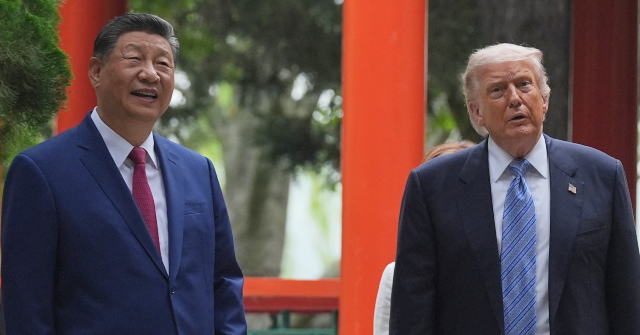
Chinese state media responded with carefully orchestrated enthusiasm to President Donald Trump’s visit to Beijing, framing his meetings with President Xi Jinping as a diplomatic watershed — even as analysts outside China’s media orbit cautioned that Beijing’s warm rhetoric concealed pointed warnings over Taiwan and regional dominance.
Symbolism at the Temple of Heaven
The state-run Global Times celebrated Trump and Xi’s joint visit to the Temple of Heaven as “a new historic footnote to China-U.S. relations,” praising the “rapid pace” of Trump’s agenda for making room for the culturally significant site. Xi used the occasion to explain the venue’s “deep symbolic weight,” linking it to the traditional Chinese concept that “the people are the foundation of a state.”
The Temple of Heaven carries particular diplomatic resonance in Beijing. Former U.S. Secretary of State Henry Kissinger — revered in Chinese political circles — visited the site 15 times, a detail Chinese state reports were quick to invoke in coverage of Trump’s visit.
The Thucydides Trap: Optimism or Warning?
At the Great Hall of the People, Xi expressed confidence that the U.S. and China could avoid the so-called Thucydides Trap — the theory, popularised by Harvard political scientist Graham Allison, that a rising power will inevitably come into violent conflict with an established one. Allison’s research found that of 17 such historical confrontations over the past five centuries, 12 escalated into large-scale military conflict.
Xi has historically been pessimistic about avoiding this dynamic. His more optimistic tone during Trump’s visit drew significant attention from the Global Times, which chose not to dwell on his previous, darker assessments.
Observers outside China’s state media apparatus were less sanguine. Free Press columnist and CBS News analyst Aaron MacLean described Xi’s invocation of the Thucydides framework as “an entirely unsubtle warning, and even a threat.”
“If Xi also offered to radically change China’s attitudes and actions, that part didn’t make the summit’s official readout,” MacLean wrote. “What was in the readout was the assertion that if the question of Taiwan is not ‘handled properly,’ then the outcome for China and America will be ‘clashes and even conflicts’ — as bald a threat as you might like.”
Taiwan: The Unresolved Fault Line
The Taiwan question cast a long shadow over Beijing’s framing of the summit. Renmin University professor Diao Daming claimed that Washington’s national security strategy, unveiled in November 2025, reflected a desire to avoid conflict in the Taiwan Strait “against its will” — a characterisation that glosses over the strategy’s actual language.
The White House document states that America’s priority is “deterring a conflict over Taiwan, ideally by preserving military overmatch” and opposing “any unilateral change to the status quo in the Taiwan Strait.” That posture — deterrence through demonstrated military superiority — differs substantially from the passive conflict-avoidance that Chinese state media implied.
The Global Times praised both leaders for embracing “stability” in a Friday editorial, using the term more than a dozen times without defining it — though the paper hinted that stability, in Beijing’s reading, is closely tied to resolving the Taiwan issue on China’s terms.
Beijing’s Diplomatic Framing
China’s state-run Xinhua news agency emphasised the personal rapport between the two leaders, highlighting their shared appreciation for cooperation and stability. Xi drew a deliberate parallel between Trump’s “Make America Great Again” agenda and China’s own national rejuvenation narrative, a rhetorical gesture calibrated to appeal to Trump’s well-documented fondness for hearing his slogans echoed by foreign heads of state.
The Chinese Foreign Ministry summarised the visit in expansive terms, stating that Trump and Xi had “agreed on a new vision of building a constructive China-U.S. relationship of strategic stability” intended to “provide strategic guidance for China-U.S. relations over the next three years and beyond.”
Even Secretary of State Marco Rubio — the most outspokenly anti-Communist figure in Trump’s delegation — was cited approvingly by the Global Times for acknowledging that “obviously, it’s in everyone’s interest to see stability in the world.”
Reading Between the Lines
MacLean also noted that Trump made no significant concessions during the summit, and criticised Allison’s framework for implying that the established power must offer substantive concessions to its rising rival as the price of peaceful coexistence — a thesis, MacLean observed, that is predictably more popular in Beijing than in Washington.
What emerged from the summit, then, is a familiar diplomatic gap: Beijing projecting consensus and shared vision; Washington projecting deterrence and conditional engagement. The language of stability, invoked repeatedly by both sides, may be the only genuine common ground — and even that word means something different depending on which side of the Taiwan Strait you are standing on.