
Malaysia’s Rohingya Crisis: How Online Hate Speech Is Displacing Refugees and Closing Schools

Malaysia has long functioned as a transit country for Rohingya Muslims fleeing systematic persecution in Myanmar. As of February 2026, the UN High Commissioner for Refugees (UNHCR) had registered 126,000 Rohingya in Malaysia, out of a total refugee and asylum-seeker population of approximately 215,600. That status — registered but legally unprotected — has always left the community exposed. What changed in April 2026 was the scale and velocity of hostility directed at them online, triggering real-world consequences that have displaced families and shuttered schools.
Understanding what happened requires starting with a structural fact: Malaysia has never ratified the 1951 Refugee Convention. Rohingya individuals registered with UNHCR carry no enforceable legal protections under Malaysian domestic law. They cannot work legally, cannot enrol in state schools, and have no formal recourse against arbitrary detention or eviction. This legal vacuum does not cause hate speech, but it amplifies its effects — there is no institutional floor beneath the community when public sentiment turns.
The current wave began with a disinformation campaign, circulating in late April 2026, that falsely claimed Rohingya refugees were demanding land allocations and special rights from the Malaysian government. The claim was fabricated, but it spread rapidly. By May, an online petition calling on Prime Minister Anwar Ibrahim to expel Rohingya refugees had gathered significant traction. Hashtags such as #SaveMalaysiaFromRohingya proliferated across platforms, amplified by Malaysian influencers with substantial followings. Institutions including UNHCR and the Human Rights Commission of Malaysia (SUHAKAM) received threats via social media.
Maryam, who works for Article 19 — an NGO focused on freedom of expression and hate speech in Malaysia — described the campaign as “undoubtedly one of the most intense in terms of both scale and duration.” Her organisation flagged problematic content to Meta, but found the platform’s moderation mechanisms too slow to contain the spread of material that was, by any measure, dehumanising. The gap between content being reported and content being actioned gave the narrative time to calcify.
On 27 July, the consequences became physical. More than 100 Rohingya refugees were forced out of their homes in Kuala Muda, a fishing village in the state of Penang, after neighbours erected signs demanding their departure. Local reporting by Sinar Harian noted that the Rohingya population in the village had grown from 108 in 2018 to around 400 by 2026 — a concentration visible enough to generate friction over access to fishing grounds. A non-Rohingya resident told Bharian that locals felt economically disadvantaged as Rohingya took up fishing, creating direct competition in a livelihood sector with little margin for new entrants.
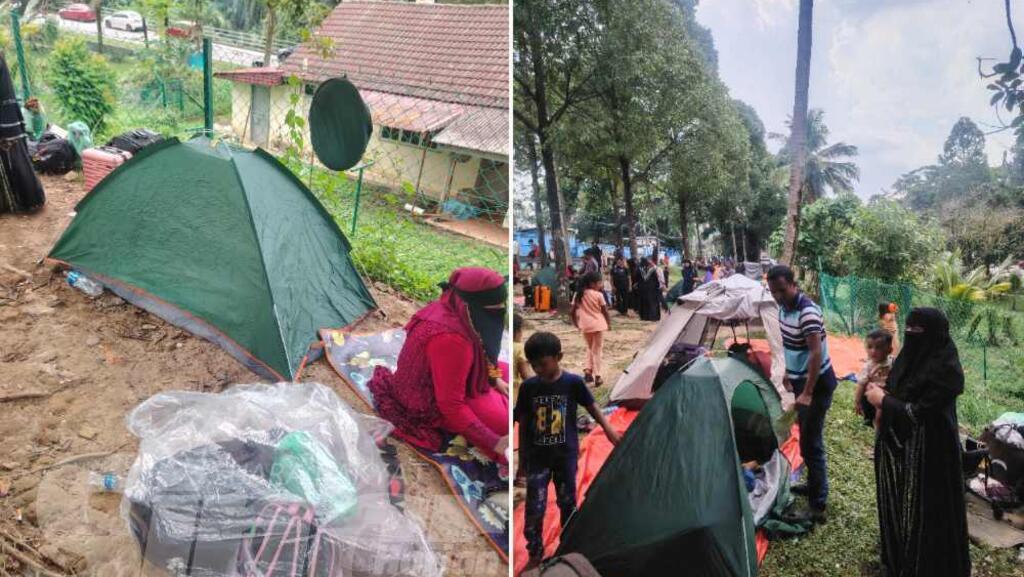
The displaced families were escorted onto buses to Kuala Lumpur, where they arrived at UNHCR’s offices seeking assistance. They erected tents outside the building while waiting for a response. Malaysian police then detained them briefly to verify their documents before releasing them into the care of local NGOs. The episode illustrated, in compressed form, the entire architecture of the community’s vulnerability: evicted by neighbours, bused to a capital city, detained by police, and ultimately handed to civil society because the state has no formal obligation to them.
Children bore a particular share of the harm. At least nine community schools serving refugee children temporarily closed their doors in response to the hostility. Amira, founder of one such NGO-run school, described children being chased and harassed on their way to class, with footage of some incidents shared online. “The content being posted is extremely radical,” she said. “It uses dehumanising and threatening language. There is a real sense of fear within the Rohingya community.”
Ahmad, a Rohingya teacher and activist in Kuala Lumpur, taught at two schools that shut down during the crisis. One remained closed for a month; the other for two weeks. When they reopened, staff advised students to avoid wearing school uniforms on their way in — a small, telling measure of how normalised the threat had become. Ahmad also noted that his students come from multiple refugee communities, but that media coverage tends to label all refugees as Rohingya, reinforcing a misconception that further concentrates hostility.
The legal situation of these schools mirrors that of the community they serve. As Amira explained, refugee schools in Malaysia operate in a regulatory grey area — not formally authorised, not formally prohibited, but permanently at risk of closure by authorities. Several have been shut down by officials in the past for lacking the necessary permits. The absence of a right to education is not incidental; it is structural, and it interacts directly with the disinformation campaigns that portray Rohingya not as refugees but as economic migrants or, in more extreme framings, as invaders.
The political response from Kuala Lumpur has been volatile. On 23 July, Malaysia’s deputy foreign minister informed Parliament that 5,000 Myanmar nationals held in immigration detention would be repatriated. On 28 July, Foreign Minister Datuk Seri Mohamad Hasan warned that Malaysia might reconsider UNHCR’s presence in the country if the agency failed to resettle more refugees abroad — a threat that, if carried out, would remove the only formal protection layer the community has. On 30 July, Prime Minister Anwar Ibrahim announced that Myanmar had agreed to accept back 5,000 Rohingya asylum seekers currently in Malaysia.
That announcement drew immediate condemnation from the Myanmar Ethnic Rohingya Human Rights Organization Malaysia (MERHROM), which stated that Rohingya returned to Myanmar would be conscripted into the military and used as human shields in its ongoing conflict against ethnic armed groups. “That is the only reason the Myanmar military has agreed to take the Rohingyas back,” the organisation said. The concern is not theoretical: the Rohingya were stripped of citizenship under Myanmar’s 1982 Citizenship Law and fled en masse in 2017 following a military campaign involving massacres, sexual violence, and the systematic destruction of villages. The International Court of Justice is currently examining genocide allegations against Myanmar arising from those events, following hearings held in January 2026.
On 5 August, Communications Minister Fahmi Fadzil appeared to walk back the repatriation commitment, stating that the government would not deport refugees facing a risk of persecution. Whether that position holds — against the backdrop of sustained public pressure, an online hate campaign still running, and a government with no treaty obligation to the community — remains an open question.
What is not open to question is the mechanism at work. Disinformation spreads faster than institutional responses can contain it. Legal statelessness removes the buffers that would otherwise absorb public hostility. And the absence of formal rights means that when pressure builds, the community has nowhere to stand except outside a UNHCR office, waiting.
The individuals interviewed for this article requested anonymity for security reasons, and their names have been changed accordingly.