

Inside Indonesia’s Prison ‘Villas’: How Luxury Quarters Flourished Behind Bars at Cibinong

What exactly was discovered at Cibinong prison?
When Indonesia’s ombudsman conducted an unannounced inspection of the Cibinong men’s correctional facility in Bogor, south of Jakarta, what they encountered bore little resemblance to the conditions one would expect inside a prison housing over 1,800 inmates at many times its intended capacity. Investigators found a cluster of private residential units — described consistently by officials as “villas” — furnished with large beds, couches, refrigerators, dining tables and wide-screen televisions. Photographs released by the ombudsman’s office showed bottles of beer, whisky and other alcohol stored in the fridge of at least one unit, as though the space were a serviced apartment rather than a cell block. The contrast with the overcrowded conditions endured by the general prison population was, by any measure, stark.
The physical infrastructure surrounding the villas compounded the scandal considerably. A swimming pool and a gym had been installed on the grounds, a luxury car parking area was documented by ombudsman official Syafrida Rachmawati Rasahan, and construction of a golf simulator was reportedly underway at the time of the inspection. Most critically, an unlocked gate connected the yard encircling these units to an adjacent bamboo forest, creating what amounted to an unmonitored exit point through which inmates could, in principle, move freely in and out of the facility. “We found the premises occupied by inmates,” Syafrida told a press conference. “We strongly suspect that in Cibinong correctional facility, there are special facilities for some inmates.”
How did these structures come to exist inside a state facility?
The prison ministry’s inspector general, Rudi Setiawan, confirmed to reporters that the funding for the villas was “not sourced from the state budget” and that no official permit had been issued for their construction. This places the structures firmly outside any sanctioned framework — they were, in the language of the ministry itself, “illegal.” The implication is that inmates, or parties acting on their behalf, financed the construction and furnishing of these private quarters and subsequently paid rent to occupy them, an arrangement that would have required the sustained complicity of prison staff at multiple levels of seniority. Setiawan acknowledged as much, stating that authorities had already received information identifying who had inhabited the buildings and who had permitted the arrangement to continue.
Cibinong houses a mixed population of detainees, including those convicted of violent offences as well as white-collar crimes such as corruption. The identity of the villa occupants has not been officially disclosed, and authorities have yet to announce what consequences, if any, those inmates will face. The question of who financed the construction — and through what channels — remains formally unanswered, though the absence of state funding points unambiguously toward private money flowing into a public institution.
What action did authorities take, and how swiftly?
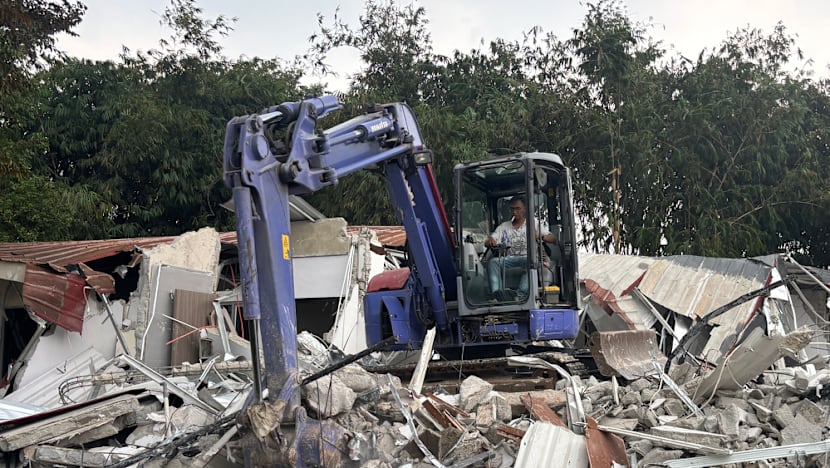
On Wednesday, 30 September, prison officers moved to dismantle the villas in a process that was both methodical and, given the circumstances, conspicuously theatrical. Staff first emptied each unit of its contents — couches, beds, coffee tables, fridges — stacking the furniture to one side before an excavator was brought in to demolish ten of the structures. The physical erasure of the villas followed the ombudsman’s public disclosure by only days, suggesting that the political pressure generated by the inspection report was sufficient to trigger rapid institutional response, even if the underlying accountability questions remain unresolved.
The head of the Cibinong prison and four other senior officials have been suspended pending investigation, and 52 inmates had been questioned as of the time of reporting. The prisons ministry indicated it would present the findings of a preliminary investigation to parliament the following week. Whether this sequence of events — demolition, suspension, parliamentary briefing — represents genuine institutional reckoning or managed optics is a question the investigation’s eventual conclusions will need to answer.
What does this reveal about Indonesia’s correctional system more broadly?
The Cibinong case is not an isolated aberration so much as a particularly well-documented instance of a structural vulnerability that has long shadowed Indonesia’s prison system: the intersection of severe overcrowding, underfunded infrastructure and the capacity of wealthy or well-connected inmates to purchase preferential treatment. A facility designed for a fraction of its current population creates conditions in which informal hierarchies and extralegal economies can take root and persist, often with the knowledge — tacit or explicit — of those responsible for oversight. The ombudsman’s visit was unannounced precisely because announced inspections tend to produce sanitised results.
The broader institutional question concerns not merely who built the villas or who lived in them, but how such an arrangement could operate for long enough to include a partially constructed golf simulator without triggering any internal reporting mechanism. That the disclosure came from an external oversight body rather than from within the corrections ministry itself is a detail worth holding onto as parliament receives its briefing. Accountability, in this instance, arrived from outside the system — which raises its own questions about the robustness of the system’s internal checks.



