
What the Absence of Chinese CEOs at Trump’s State Dinner Reveals About US-China Business Ties

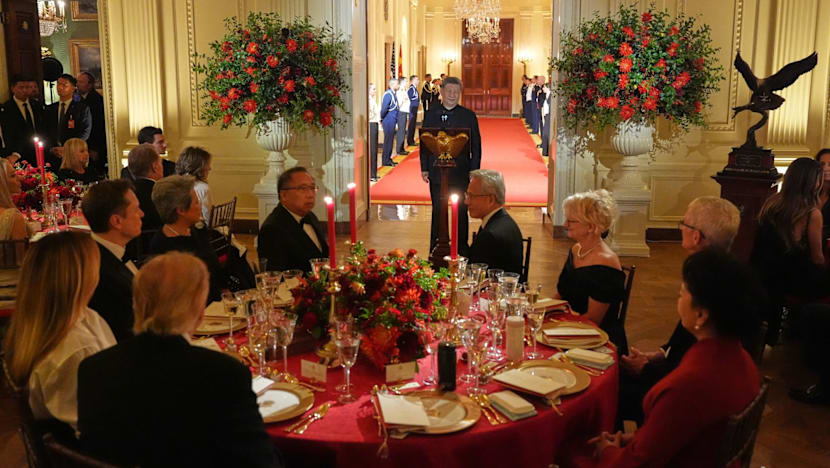
There is something quietly telling about a state dinner where one side fills the room with its most powerful corporate names and the other sends only officials. When Chinese President Xi Jinping sat down with US President Donald Trump at the White House on a Thursday evening in late September, more than thirty American business leaders occupied the surrounding tables — Elon Musk, Jensen Huang, Tim Cook, Jeff Bezos, Mark Zuckerberg and Jamie Dimon among them. Across from that constellation of private capital sat sixteen members of Xi’s delegation, every one of them a government or party official. Not a single Chinese CEO was present.
The contrast was not incidental. It was structural, and it repays careful reading.
Xi’s delegation was, by any measure, substantive on the policy side. Vice Premier He Lifeng, China’s lead trade negotiator, attended alongside National Development and Reform Commission chairman Zheng Shanjie, Commerce Minister Wang Wentao and Finance Minister Lan Fo’an. De facto chief of staff Cai Qi and Foreign Minister Wang Yi were also in the room. These are the people who actually move the levers of China’s economic policy, and their presence matters more at the negotiating table than any number of corporate delegates. Analysts were quick to note as much. But the corporate vacuum still carries its own signal — one that illuminates the structural divergence between how Washington and Beijing conceive of the relationship between business and statecraft.
The asymmetry was sharper still when set against recent precedent. When Trump visited Beijing in May, Chinese executives dined alongside their American counterparts at Xi’s state banquet. Lenovo’s Yang Yuanqing, Xiaomi founder Lei Jun and ByteDance CEO Liang Rubo were all present, and Trump introduced the American executives to Xi one by one. During Xi’s previous US state visit in 2015, Alibaba’s Jack Ma and Tencent’s Pony Ma participated in a bilateral CEO roundtable in Seattle. The absence this time was not a default; it was a departure.
Beijing had apparently sought to bring a business delegation. Reports named executives from BYD, Xiaomi, CATL and Zhongji Innolight as candidates. The plans collapsed. Washington’s stated objection was one of security clearance — US officials reportedly did not want firms they believe maintain links to China’s military represented at the dinner. CATL, one of the firms under consideration, had been added to the Pentagon’s list of alleged military-linked companies in January 2025, a designation the battery maker disputes. A second source told Reuters that the White House simply had other priorities.
Lin Han-Shen, China director at US strategic advisory firm The Asia Group, observed that the two governments approached the guest list with fundamentally different logics. For Beijing, a CEO delegation was intended as a diplomatic deliverable — tangible proof that improving bilateral ties could translate into commercial access for Chinese firms in the American market. China framed it as a matter of reciprocity, given that US executives including Huang and Cook had flown to Beijing on Air Force One in May. Washington, by contrast, treated attendance as a function of security vetting rather than diplomatic gesture. The gap between those two framings is itself instructive.
“The absence of CEOs reinforces that Chinese firms remain instruments of policy, not independent diplomatic actors in the way US companies are,” Lin said. Drew Thompson, a senior fellow at the S Rajaratnam School of International Studies in Singapore, put it more bluntly: “It’s not Air China that’s buying Boeings, it’s the Communist Party.” The remark cuts to the core of the structural difference. In China’s political economy, major commercial decisions — including the approval of an initial 200-aircraft Boeing purchase announced in May, the first such commitment since 2017 — flow through the party apparatus. Corporate leaders do not arrive at summits as independent interlocutors; they arrive, when they arrive at all, as extensions of state intent.
Thompson also cautioned against a symmetrical misreading of the American side. The US executives present at the dinner were not there solely to court Beijing. “I think those CEOs are as much courting US Cabinet members responsible for the economy, like Treasury Secretary Scott Bessent, as well as President Trump and his family,” he said. Had Chinese executives attended, he added, they would similarly have valued proximity to Xi as much as access to their American counterparts. The dinner was, in that sense, a domestic political event as much as a bilateral one — a point that complicates any straightforward reading of the corporate imbalance.
What the absence does illuminate, with some precision, is the limited ground that Washington and Beijing have actually covered on trade and investment despite months of stabilisation efforts. Both sides agreed in May to establish a Board of Trade and a Board of Investment, mechanisms intended to manage bilateral commerce across non-sensitive goods and provide a government-to-government forum for investment discussions. Neither board was mentioned by name in China’s official readout of September’s summit talks. Xi noted that the two sides’ economic teams had reached “a new joint arrangement” without specifying its scope. The clearest concrete movement came just before the summit, when Bessent announced a two-month extension of the existing trade truce to January 10 — additional runway, as Lin put it, to negotiate the broader economic relationship rather than face an abrupt November cliff.
Thompson assessed the summit as producing no major economic breakthroughs. The underlying structural obstacles remain formidable. In China, nearly every industry carries a security dimension, which makes genuine market opening politically difficult for Beijing to offer. In the United States, Chinese goods and companies face their own national security filters — from data handling to sensors and network infrastructure. “There isn’t any agreement on the two sides about what industries should be considered national security,” Thompson observed. Without that foundational consensus, reciprocal market access remains an aspiration rather than a negotiable commodity.
George Chen, a partner at The Asia Group, argued that the corporate imbalance should not be over-interpreted: “The absence of a CEO entourage may change the optics, but it does not alter the substance of the summit.” That is true as far as it goes. But optics in diplomacy are never purely decorative. The image of a room full of American private capital facing a wall of Chinese state officials encodes something real about the architecture of each country’s political economy — and about the structural friction that will continue to constrain any deal-making between them. As Thompson put it, the message is that China remains ambivalent about making the trade relationship more reciprocal and more beneficial to American companies. An empty chair, it turns out, can carry considerable diplomatic weight.