

China and Thailand Pledge Deeper Tech Cooperation in Push for ‘Shared Prosperity’

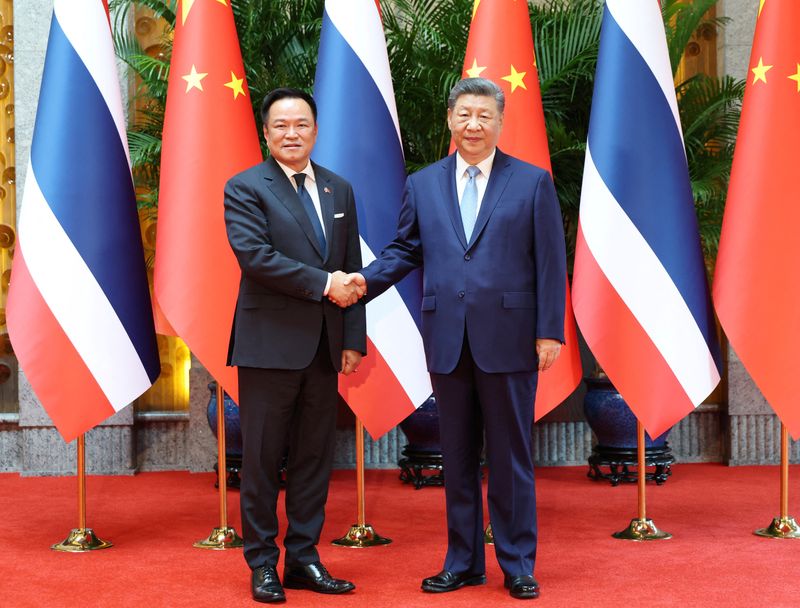
The groundwork for Monday’s joint statement had been laid over months of high-level engagement. Since last year, Beijing and Bangkok had maintained a steady rhythm of diplomatic contact, steadily expanding the scope of what both governments were willing to put on paper. That accumulated momentum reached a formal articulation when Thai Prime Minister Anutin Charnvirakul arrived in Beijing for a five-day visit — one that concluded late Monday with a joint statement committing both nations to a substantially deeper bilateral relationship.
The document’s language was deliberate. A “prosperous shared future” framed the overarching ambition, but the operational content was specific: the two sides pledged to align policies across technology and innovation sectors, expand people-to-people and institutional exchanges, and deepen cooperation in fields ranging from health and agricultural technology to artificial intelligence, advanced electronic devices, aerospace, and clean energy. Geospatial information and advanced materials also featured — sectors that carry both civilian and strategic weight.
“Technological progress and digital transformation create tremendous new opportunities for both countries,” the statement read.
Beyond the headline sectors, the two governments agreed to strengthen industry-to-industry and academic research cooperation, with an explicit aim of securing and fortifying their respective supply chains. That framing matters. In the current global environment, supply chain resilience has become a proxy for strategic alignment, and Beijing’s interest in locking in partnerships with ASEAN neighbours — particularly those with established manufacturing bases like Thailand — reflects a structural logic that goes beyond bilateral goodwill.
Infrastructure commitments reinforced the economic dimension. Thailand reaffirmed its intention to complete a 250-kilometre section of the China-Thailand high-speed railway by 2030, a project that has moved slowly since its original conception but now carries renewed political momentum. The railway sits at the intersection of connectivity ambition and regional influence — a physical instantiation of the partnership both governments are describing in softer terms.
The two countries also agreed to strengthen coordination in foreign affairs and defence matters, a line that will register differently depending on where one sits in the region. For Bangkok, the framing offers diplomatic flexibility. For Beijing, it represents another node in a network of bilateral arrangements that, taken together, shape the strategic texture of mainland Southeast Asia.