
New START treaty expires, ending formal limits on US and Russian nuclear deployments

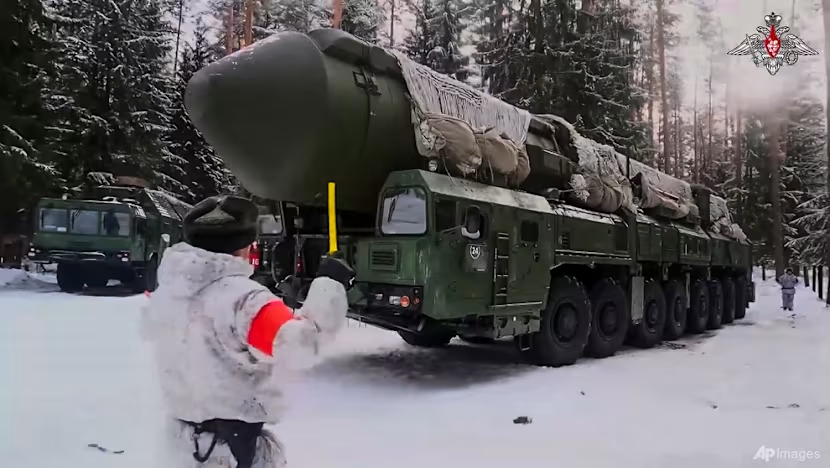
The New START treaty, the last remaining nuclear arms control agreement between the United States and Russia, expired on Thursday, February 5, ending decades of formal, verifiable limits on how many strategic nuclear warheads the two countries can deploy.
United Nations Secretary-General Antonio Guterres described the expiry as a “grave moment for international peace and security” and urged Washington and Moscow to return to negotiations without delay. In a statement, he warned that for the first time in more than half a century there is no treaty-based framework limiting the world’s two largest nuclear arsenals.
Russia had signalled willingness to continue observing New START’s central limits beyond the deadline, but said it did not receive a formal US response before the treaty lapsed, according to reporting by Channel NewsAsia.
What the New START treaty did
Signed in 2010 by then US President Barack Obama and then Russian President Dmitry Medvedev, New START set caps on deployed strategic nuclear forces. It limited each side to 1,550 deployed strategic warheads and no more than 700 deployed delivery vehicles — intercontinental ballistic missiles, submarine-launched ballistic missiles and heavy bombers.
A central feature of New START was its verification regime, which included regular data exchanges and short-notice, on-site inspections designed to reduce uncertainty and the risk of miscalculation.
Inspections were paused during the COVID-19 pandemic and did not resume. Russia later said it could not permit US inspections while the United States and its NATO allies were, in Moscow’s view, pursuing Russia’s defeat in the war in Ukraine. With inspections halted, each side relied more heavily on national intelligence to assess the other’s posture, even as both governments said they would continue to respect the treaty’s numerical limits until the expiration date.
Why it expired now
New START allowed a single extension of up to five years. The United States and Russia used that option in early 2021, pushing the treaty’s end date to February 5, 2026.
In 2025, Russian President Vladimir Putin proposed that both countries informally continue observing New START’s key caps for an additional year. The proposal did not result in a formal arrangement before the deadline, leaving no successor agreement or interim framework in place when the treaty lapsed.
China’s role in Washington’s calculations
US officials and analysts have increasingly linked future arms control to China’s expanding nuclear capabilities. While China remains well below US and Russian levels, its rapid buildup has fuelled concern in Washington about deterring two major nuclear competitors simultaneously.
Some US officials have argued that a future arms control framework should include China, and that limits that bind only Washington and Moscow could constrain US flexibility if Beijing continues expanding. China has rejected participation in such negotiations “at this stage,” arguing that its nuclear forces are on a different scale than those of the United States and Russia.
Russia and the United States together hold the vast majority of the world’s nuclear warheads, meaning the end of treaty-based limits between them has implications for global stability even as nuclear dynamics become more multipolar.
What comes next without treaty limits
With New START expired, the United States and Russia are no longer bound by the treaty’s caps or its transparency mechanisms. Arms control experts say the loss of predictability and verification increases incentives for worst-case planning and could encourage both sides to adjust deployments to signal resolve or gain leverage.
Analysts have also warned that the absence of limits could accelerate development and deployment of newer systems. Russia has previously highlighted “non-traditional” delivery concepts, while US officials have noted that Washington would have greater freedom to increase the number of warheads deployed on existing missiles if it chose to do so.
Beyond the US-Russia balance, many experts see a heightened risk of action-reaction cycles involving China as it continues modernising its nuclear force. At the same time, some argue the treaty’s expiry may force a broader rethink of arms control, including how to address newer technologies and delivery systems that fall outside the traditional counting rules used for decades.
The UN has urged both Washington and Moscow to re-engage on strategic stability talks to reduce risks and rebuild guardrails, warning that the consequences of an unconstrained nuclear competition would extend far beyond the two countries.