

Singapore’s Public Service Must Move From Governing ‘For’ Citizens to Governing ‘With’ Them, Chan Chun Sing Says

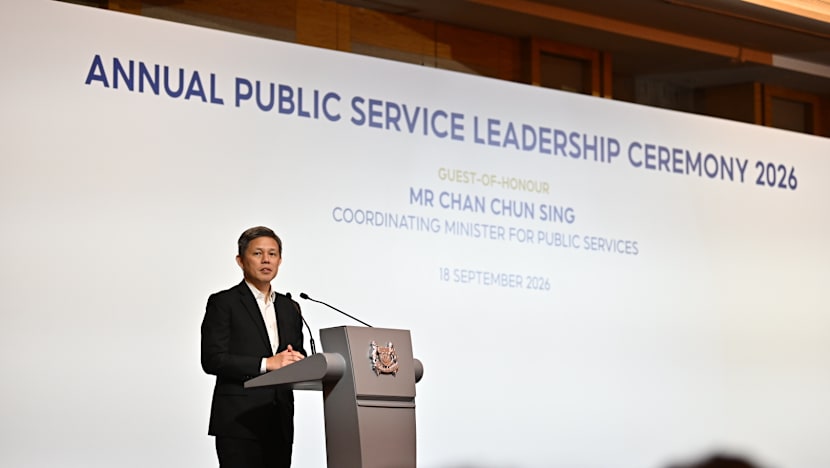
The room held around 800 public servants, gathered at Marina Bay Sands for a leadership ceremony, when Coordinating Minister for Public Services Chan Chun Sing put to them a distinction that sounds simple but carries considerable institutional weight: the difference between doing things “for” Singaporeans and doing things “with” them. It is a shift in posture that the public service, however capable and well-resourced, has not fully made — and Mr Chan, who also serves as defence minister, was direct about the gap.
The occasion was a leadership investiture on Friday, 18 September, but the speech ranged well beyond ceremony. Mr Chan drew on two recent and politically sensitive cases — the proposed residential developments at Maju Forest and Gillman Barracks — to illustrate where the current model of governance can fall short. Both sites had drawn significant public opposition earlier this year, with residents and nature groups pressing for stronger environmental protections; the government ultimately revised its plans, retaining more greenery and scaling back the number of homes. What the episode exposed, in Mr Chan’s reading, was not simply a planning misstep but a deficit in how trade-offs are communicated and shared with the public before decisions harden into policy.
“Everyone has their preferred outcomes, everyone has their strongly held personal convictions,” he told the assembled officers. “But there is a need to align on the bigger picture, the trade-offs and the range of considerations — housing needs, land use, energy, transport, and even sewage planning.” The candour is notable. Singapore’s administrative tradition has long favoured technocratic authority, the implicit assurance that the civil service has already weighed the variables so citizens need not. What Mr Chan appeared to be proposing is something structurally different: a public service that convenes stakeholders, listens to competing interests, and surfaces the costs of every choice rather than presenting only its conclusions.
This is not merely a question of public relations. It reflects a broader reckoning with the nature of modern governance challenges, which Mr Chan described as increasingly interconnected and resistant to resolution within any single agency’s remit. Workforce transformation, he noted, must simultaneously absorb the disruption wrought by artificial intelligence, capture the productivity opportunities it presents, accommodate an ageing population, and sustain economic growth — all at once, and all across institutional boundaries that were drawn for a simpler era. The civil service architecture that Singapore built in the decades after independence was designed for legibility and execution; the problems arriving now are neither legible nor contained.
Mr Chan’s prescription for this complexity was threefold, and each element deserves examination on its own terms. The first is epistemic humility: public servants, he argued, do not need to possess every answer or capability themselves, but must be “clear-eyed” about what falls within their remit and what is better handled by citizens, communities, or businesses. The second is international exposure, which Mr Chan framed not as a perk of seniority but as a strategic necessity. He urged officers to pursue civil service exchange programmes, overseas attachments to international organisations, and bilateral postings — arguing that these experiences build the networks and contextual understanding that no briefing paper can replicate. The third is proactive innovation: rather than waiting for frameworks to fail, the public service should continuously experiment and reimagine, as it did when Singapore co-created the world’s first digital economy partnership agreement with Chile and New Zealand.
On the geopolitical dimension, Mr Chan was careful to frame Singapore’s current moment as opportunity rather than threat. The messier global landscape, he suggested, creates openings for new partnerships with like-minded states — pointing to Singapore’s bilateral relationships with Australia and New Zealand, and to its upcoming ASEAN chairmanship, as deliberate efforts to construct cooperative space rather than mere diplomatic convention. “These are not partnerships of convenience,” he said. “They are deliberate efforts to create new space for cooperation and advance our shared interests.” The framing matters: it positions Singapore’s civil service not as a passive administrator of a small state’s constraints, but as an active architect of the institutional arrangements that give the city-state its strategic relevance.
What runs through all of it is a single underlying argument about legitimacy. When Mr Chan says that “every generation must earn our relevance anew,” he is acknowledging something that Singapore’s governance model has sometimes been reluctant to state plainly: that institutional authority, however well-earned historically, cannot be inherited indefinitely. The public servants in that room at Marina Bay Sands were being asked to do more than execute policy competently — they were being asked to rebuild, continuously, the social compact that makes competent execution meaningful in the first place. Whether the machinery of the civil service, with its established hierarchies and performance frameworks, can genuinely absorb that kind of participatory ambition remains the harder question, and one that Friday’s ceremony left open.



