

How AI Is Reshaping Warfare — And Why Singapore’s Military Still Needs People

Artificial intelligence is rewriting the logic of modern warfare with a speed that few institutions anticipated. For the Singapore Armed Forces (SAF), navigating this shift is not a distant strategic exercise — it is an immediate operational imperative, one that Defence Minister Chan Chun Sing addressed directly at a dialogue on 24 June and again in his SAF Day message on 1 July.
The minister’s framing was deliberate: he paid tribute to the dedication of SAF servicemen and women, and anchored Singapore’s security in the resolve of its people. That emphasis on human commitment is not rhetorical filler. It carries analytical weight at a moment when AI is being woven into targeting systems, drone networks and cyber operations across the world’s most active conflict zones.
What is AI actually doing on the battlefield today?
The operational applications are already well beyond the experimental. The Israeli military reportedly used machine learning systems to process intelligence data and recommend strike targets during its operations in Gaza. The United States applied large language models during its military operation against Iran to prioritise targets and plan strikes within a fluid combat environment. These are not prototype deployments — they are live, consequential uses of AI in active conflict.
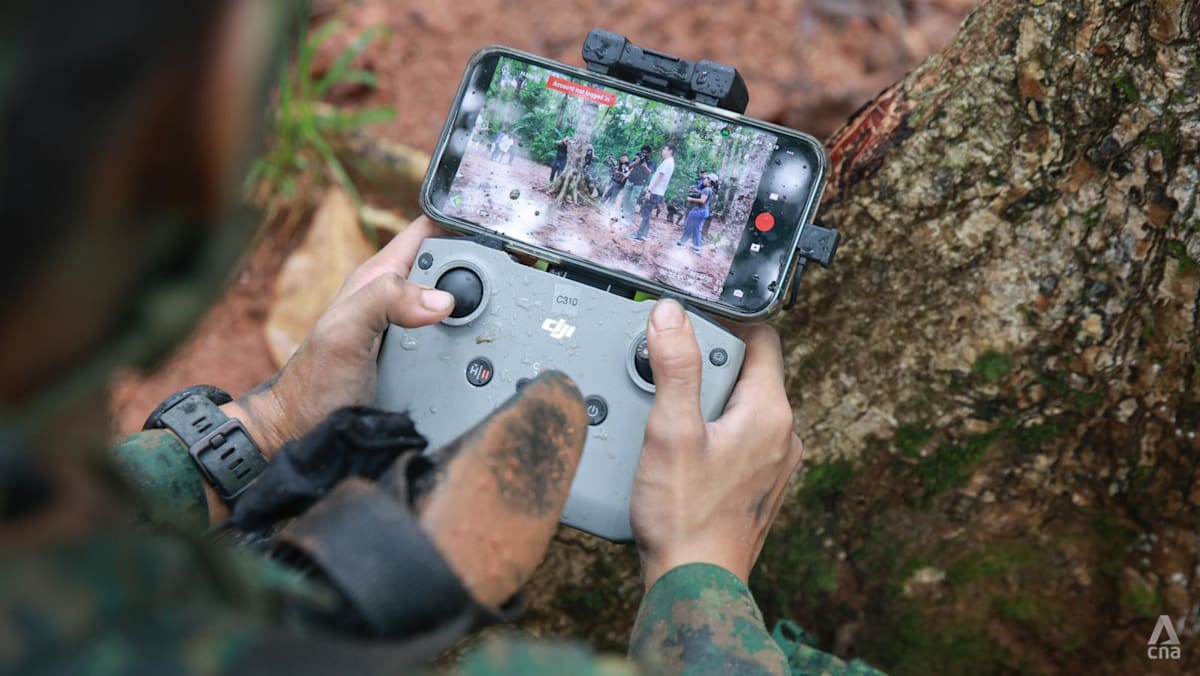
Drone warfare has become the most visible expression of this shift. Ukrainian and Russian forces have each demonstrated how unmanned systems transform the tempo and geography of combat, and Iran’s drone deployments against US-aligned targets in the region reinforced the point. What is coming next is more unsettling: experts anticipate autonomous guidance systems capable of searching wide battlefield areas, identifying targets and initiating strikes without human instruction.
Beyond kinetic operations, AI accelerates cyber offensives and information warfare. It can generate fake content, populate bot networks and amplify disinformation at a scale no human team could match — deepening societal fractures before a single shot is fired. At the administrative end, AI also streamlines the back-end machinery of large militaries: logistics, procurement, human resources, finance planning. The technology operates across the full spectrum, from strategic influence to supply chain management.
Why humans cannot be taken out of the equation
The scale of these capabilities raises an obvious question: does AI eventually displace the soldier? The evidence, and Singapore’s own doctrine, points firmly in the other direction. Minister Chan stated plainly that despite AI’s role in accelerating decisions — target acquisition, weapons selection — there must remain a “man in the loop.” His reasoning was precise: an overreliance on autonomous systems amounts to a “dereliction of duty… to an algorithm that you do not understand.”
For a conscript military like Singapore’s, this is not merely a philosophical position. Mission success depends on the vigilance, training and commitment of personnel in ways that the best-in-class hardware cannot substitute. The stakes of getting this wrong are literal: life-or-death decisions made in combat cannot be fully delegated to systems that exhibit known flaws, including bias, hallucination, sycophancy and an inability to reason through ethical constraints.
There is also a structural reality that shapes how any military can adopt AI: the expertise is concentrated in the private sector. Effective integration requires deep partnerships with AI developers, technology companies and independent evaluators who understand both what these systems can do and where they reliably fail. Militaries cannot build this capability in isolation. Policies, guardrails, training protocols and human oversight mechanisms are prerequisites, not optional refinements.
Minister Chan’s SAF Day message captured the asymmetry that makes this so demanding. “Each action signals our determination to get it right, first time, all the time. For our adversaries, they are looking to get it right one time, any time.” That asymmetry — between a small state that cannot absorb strategic failure and adversaries who can absorb repeated attempts — is precisely why Singapore cannot afford to mismanage the human-machine relationship in its armed forces.
The decisions ahead — how to invest in AI, how to build the supporting infrastructure of computing power and data centres, how to develop leaders with the strategic foresight to manage these systems responsibly — all demand human judgment at the centre. The argument for enhanced human-machine collaboration, rather than wholesale technological substitution, is not a conservative instinct. It is the analytically sound position, given where AI capability and AI risk both currently stand.