
China Reclaims World’s Fastest Supercomputer Title for First Time Since 2017

China Reclaims World’s Fastest Supercomputer Title for First Time Since 2017
A Chinese supercomputer has dethroned its American rivals to claim the top spot on the world’s most authoritative high-performance computing ranking — the first time Beijing has held that position in eight years, in a development that carries significant weight amid escalating US-China technology competition.
LineShine Debuts at Number One
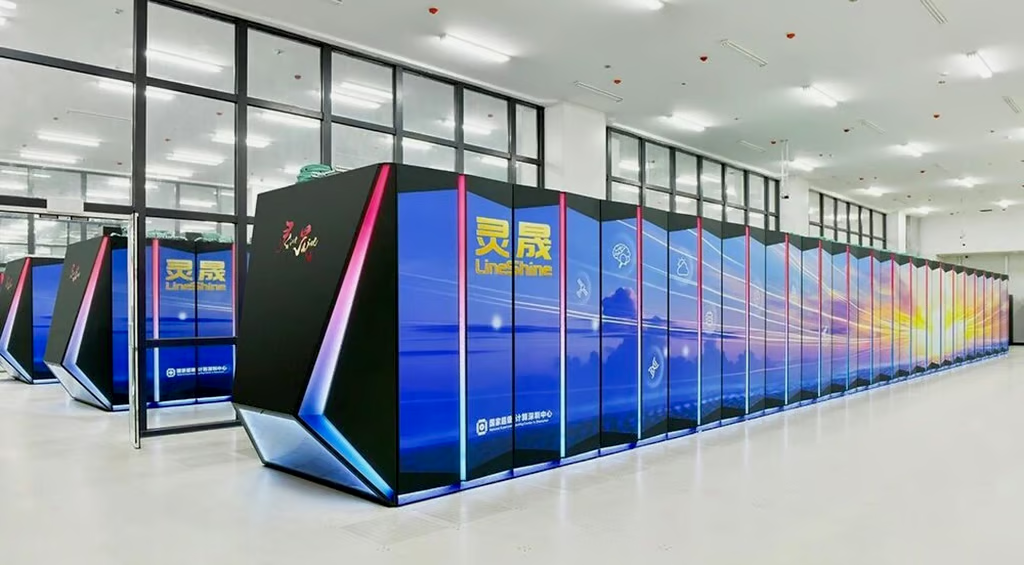
The LineShine supercomputer, housed at China’s National Supercomputing Center in Shenzhen, made its debut on the TOP500 list this week, immediately displacing the American machine El Capitan from the top position. The ranking, widely regarded as a benchmark of national technological capability, was announced Tuesday.
LineShine recorded a performance of 2.198 exaflops — meaning it executes more than two quintillion calculations per second — surpassing El Capitan, which now ranks second.
The Full Leaderboard
El Capitan, operated by the US government’s Lawrence Livermore National Laboratory in California, is followed by two other American supercomputers at national laboratories in Tennessee and Illinois. Germany’s Jupiter supercomputer falls to fifth place. All five machines are the only publicly verified exascale computers in the world.
A Different Architectural Bet
LineShine’s design sets it apart from the prevailing industry approach. While most high-performance machines rely on graphics processing units (GPUs) — the chips that also power artificial intelligence workloads — LineShine runs entirely on conventional central processing units (CPUs).
The machine consumes approximately 42.2 megawatts of electricity to operate, according to TOP500 data — a significant energy footprint that underscores the scale of the infrastructure investment behind China’s computing ambitions.
Strategic Implications
The shift at the top of the TOP500 list arrives as Washington continues to restrict China’s access to advanced semiconductor technology, including high-end Nvidia GPUs. LineShine’s CPU-only architecture suggests Chinese engineers are engineering around those constraints rather than waiting for them to ease.
The last time a Chinese supercomputer led the TOP500 was in 2017, when the Sunway TaihuLight held the position. That China has returned to the summit — on the back of domestically viable chip technology — will be read in both Washington and Beijing as more than a technical milestone.