

Fertility Decline Demands More Working Women, Not More Babies

India’s Fertility Decline Demands More Working Women, Not More Babies
India’s fertility rate has fallen to 1.9, according to the Sample Registration System (SRS) 2024 report, triggering alarm among economists about the country’s long-term growth trajectory. The data, released last month, have forced a dramatic revision of population projections — and exposed a structural vulnerability that financial incentives alone cannot fix.
The Baby Bonus Trap
Across Asia and Europe, governments facing declining birth rates have turned to financial incentives: cash transfers, extended maternity leave, and childcare subsidies. The results have been consistently underwhelming. Birth rates have continued to fall regardless of the size of the cheque.
India appears poised to repeat the same experiment. Andhra Pradesh Chief Minister N. Chandrababu Naidu has already announced a population care programme offering financial and maternity leave incentives to families who have three or four children. Other states are expected to follow.
The evidence suggests such schemes will not work. The causes of falling fertility extend well beyond the cost of raising children — they are rooted in urbanisation, education, shifting aspirations, and structural changes in labour markets. Money cannot reverse those forces.
A Demographic Dividend Quietly Disappearing
The SRS 2024 data have fundamentally redrawn India’s demographic outlook. Previous projections by the UNDP, based on the 2011 census, estimated India’s population would peak at 1.7 billion in the early 2060s. Updated projections now suggest the peak will arrive two decades earlier — at 1.6 billion by the mid-2040s — followed by a decline likely faster than the rate of growth.
In practical terms, India has lost an estimated 100 million future citizens: workers and consumers who were expected to power the country’s economic ascent. The demographic dividend that policymakers counted on has, in the words of one analyst, “suddenly vanished.”
Eight Indian states now record fertility rates of 1.5 or below — levels comparable to Scandinavia. India remains a lower-middle-income country. It is, as one Columbia University economist puts it, facing “the worries of the rich world without their riches.”
The North-South Divide Is a Myth
A widely held assumption — that India’s fertility crisis is a southern problem, with northern states still reproducing at replacement level — no longer holds. The SRS 2024 data show that fertility is below replacement rate across India, with the exception of five states in the Hindi belt.
The states with the lowest fertility rates span the country’s geography:
The convergence has significant political implications. The outcome of the long-delayed delimitation exercise — a redrawing of parliamentary constituency boundaries — may shift less than anticipated if the central government uses SRS 2024 projections rather than the 2011 census. Analysts argue it should.
The Untapped Workforce
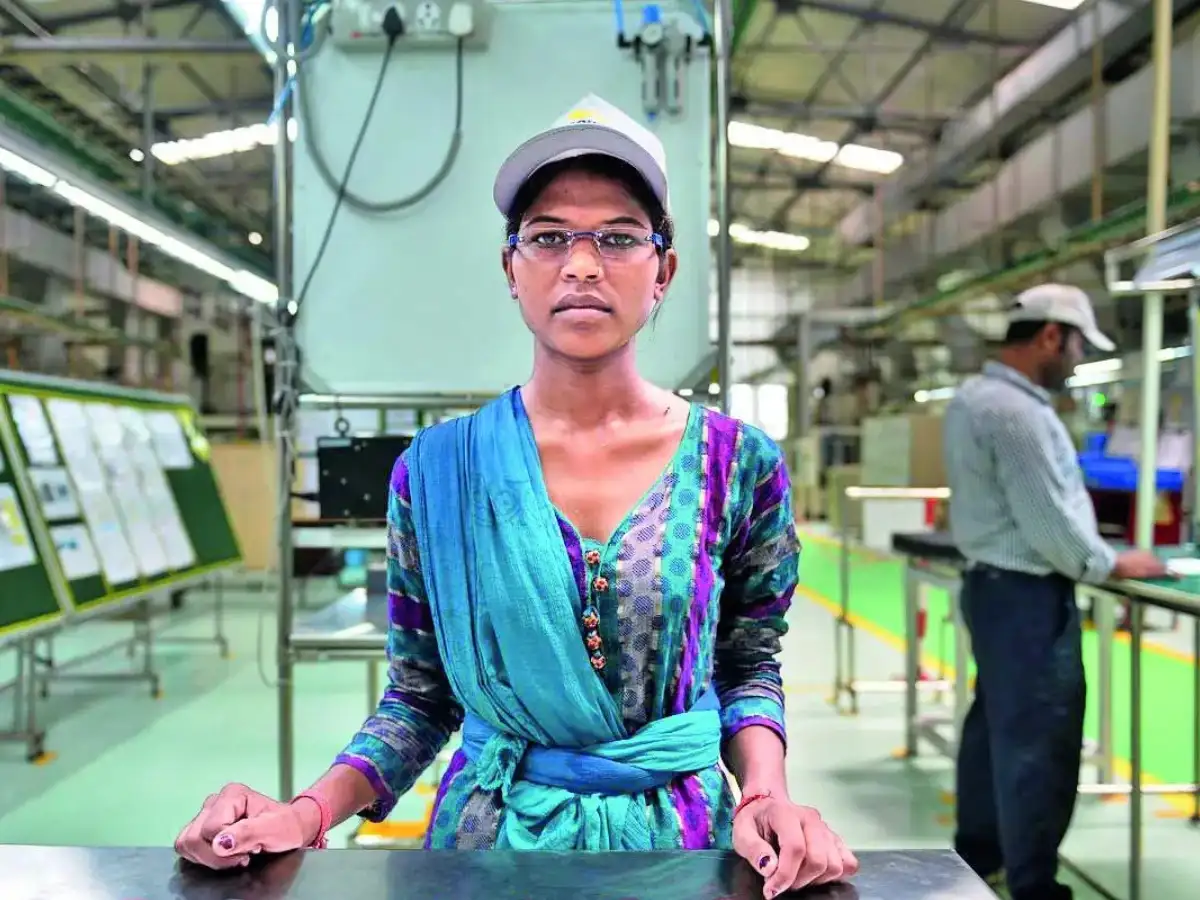
The structural answer to India’s demographic challenge lies not in the maternity ward but in the labour market. India’s female labour force participation rate sits at 35 to 40 percent — among the lowest in the world, and well below the global average.
Japan offers a relevant precedent. Confronting falling fertility earlier than most, it raised women’s workforce participation from 57 percent in 1990 to 77 percent in 2025. South Korea, which has recorded the steepest fertility decline of any country globally, lifted female participation from 49 percent to 64 percent over the same period.
Both countries achieved these shifts despite starting from gender norms broadly comparable to India’s. The transitions were neither painless nor instantaneous, but they were real.
India’s untapped reservoir of working-age women — historically confined to roles as homemakers and caregivers — represents a substantial and largely unrealised economic asset. Mobilising even a fraction of this population into formal employment could sustain workforce growth for decades, offsetting the demographic contraction now underway.
Structural Change, Not Symbolic Policy
Achieving higher female workforce participation requires more than awareness campaigns. It demands affordable childcare, elder care infrastructure, legal protections against workplace discrimination, and — critically — a shift in household gender norms that distributes domestic labour more equitably between men and women.
In the short term, the transition to a slower-growing, ageing population need not be catastrophic. Businesses will adjust their investment and consumer strategies. Local governments will need to reorient spending toward elderly care rather than youth infrastructure.
The longer-term calculus is less forgiving. Without a sustained increase in women’s workforce participation, India’s path to developed-nation status becomes structurally constrained — not by a shortage of ambition, but by a failure to deploy half its human capital.
Analysis draws on commentary by a professor of social policy at Columbia University, New York.