

Nanning’s Blue Ocean Promise: How Singaporean Firms Are Navigating China’s Less-Charted Markets

The Case for Nanning
Nanning is not where most Singaporean executives look when they think of China. Beijing, Shanghai, Guangzhou, Shenzhen — these are the cities that dominate the imagination, and for good reason: they concentrate capital, infrastructure, and institutional familiarity. Yet it is precisely that concentration which has made them, in the vocabulary of business strategy, a red ocean — saturated, fiercely competitive, and expensive to enter. The thesis that an increasing number of Singaporean firms are acting on is simpler and more contrarian: Guangxi’s capital, long overlooked, represents a blue ocean, a less contested market where the cost of entry is lower and the relationships still worth building.
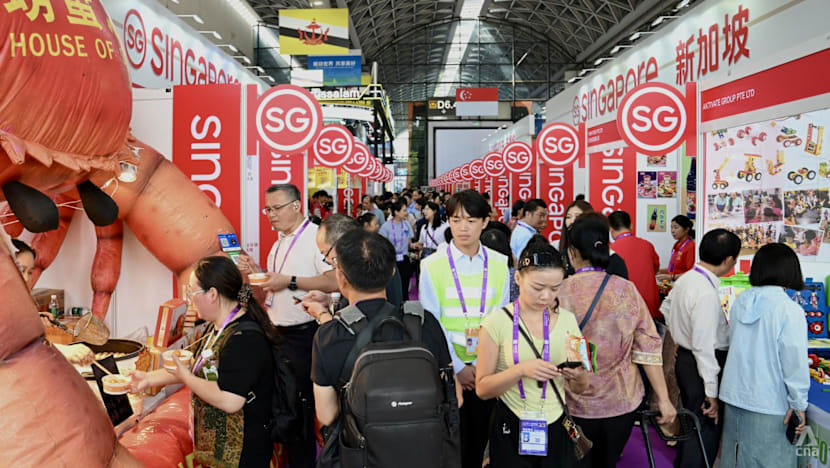
This year’s China-ASEAN Expo, held in Nanning from September 17 to 21, drew more than 50 Singaporean exhibitors — the highest count since 2023. Some arrived to test the market for the first time; others were deepening ties cultivated over several years of careful, incremental relationship-building. What they share is a willingness to engage with a market that demands patience, local knowledge, and a tolerance for ambiguity that Singapore’s relatively transparent business environment does not always train companies to develop.
The timing is not incidental. The Pinglu Canal, which opened this month, now gives Nanning and the broader southwestern interior of China a shorter water route to the sea, tightening Guangxi’s role as a logistical link between China and Southeast Asia. Senior Minister Lee Hsien Loong visited Guangxi in May, with the Ministry of Foreign Affairs describing the region as a “key gateway” connecting China with ASEAN. The political architecture around Nanning is being deliberately reinforced, and Singapore’s business community is reading those signals.
Building Relationships in a Market That Does Not Reward Shortcuts
Tan Teck Yong, chairman and CEO of KinderWorld International Group, has attended the Nanning expo three times since the COVID-19 pandemic. His education company first entered China in 2000, and his framing of the opportunity is direct: first-tier Chinese cities are overcrowded; Guangxi is where meaningful growth remains possible. That assessment, however, did not translate quickly into business. Tan spent a year and a half in discussions before KinderWorld’s plans in Guangxi began to take concrete shape, eventually signing agreements with local education institutions.
Wayne Eo, director of building materials company Sixth Harmony Global, arrived at his first CAEXPO in 2024 knowing little about Nanning beyond a vague sense that it was an “up-and-coming second-tier city.” What he found was modern high-rises, active shopping districts, and a business culture that rewarded sustained presence over transactional efficiency. Through successive expo appearances and careful relationship cultivation, Sixth Harmony has since expanded its customer base beyond Nanning into broader Guangxi and into Guangdong. “Nanning is the entry point for us,” Eo said — not the destination, but the threshold.
His approach to building those relationships is methodical and deliberately slow. It begins with small transactions: monitoring whether payments arrive on time, assessing whether working styles align, allowing trust to accumulate before committing to larger volumes of business. “We build some form of relationship, and have an understanding of each other. Then we trial a little bit of business here and there,” he explained. For a company of Sixth Harmony’s scale, even a marginal share of China’s construction materials market carries significant commercial weight — but that share is earned over months, not weeks.
Tracy Low, sales director at Kim’s Duet, a company selling Singapore-style coffee in single-serve sachets, came to CAEXPO this year with a more immediate objective: finding a distributor. She left with several potential candidates and a realistic timeline of three to six months simply to evaluate them before any formal engagement. The Chinese market, as she understands it, is not one her company can read from Singapore. The purpose of the trip was precisely to close that distance.
The Shadow of the Pyramid Scheme Arrests
Nanning’s recent visibility has not been entirely flattering. In a separate and troubling development, 52 Singaporeans were arrested in Guangxi over suspected involvement in pyramid scheme activities — part of a pattern of investment pitches that promised returns so high as to strain credulity. Zhang Fan, a 40-year-old Singaporean working in cybersecurity, recalled being approached late last year by a university friend with a proposal framing Nanning as a strategic node that could become “the next Shanghai” within a decade. The pitch involved investments of S$40,000 to S$50,000, with projected returns exceeding S$1 million over two years. Zhang turned it down. “It sounded too good to be true,” he said.
The distinction between legitimate market entry and fraudulent investment schemes matters enormously here, and the legal community has been clear about what separates them. Liang Weitan, a partner in the China Practice at WongPartnership, advises that genuine projects should have identifiable partners, proper business registrations, enforceable contracts, transparent funding structures, and demonstrable commercial operations. Visiting a company’s premises, examining its business licence, and establishing precisely how a project generates revenue before transferring any funds are not optional precautions — they are the baseline. “The absence of any of these should prompt further inquiry,” Liang said.
Samuel Chng, a research assistant professor at the Lee Kuan Yew Centre for Innovative Cities at SUTD, adds a behavioural dimension to that legal framework. Even markets that are genuinely promising can harbour unsound ventures, and the excitement of a large opportunity is precisely the condition under which due diligence is most likely to be skipped. “It would be prudent to pause and ask what evidence supports a particular business proposition, how it generates revenue, and whether its claims can be checked independently of those promoting it,” Chng said.
For the businesses at CAEXPO, the arrests have registered as background noise rather than deterrent. The Singapore Business Federation reported no uptick in concerns from companies about entering Nanning following the news. KinderWorld’s Tan was unequivocal: “So far, no impact. We are not here to look for money. We are here to bring our export, our education program into Guangxi and China.” Low echoed that position — her company’s presence in Nanning was motivated by curiosity about the market, not by the kind of return-maximising logic that makes pyramid schemes appealing in the first place.
What Structural Realism Looks Like
The Singapore Business Federation has been facilitating introductions between local companies and potential Chinese partners, but it has also been careful to define the limits of that role. An introduction, SBF executive director Soo Wei-Chieh stressed, is not an endorsement. “What works for one may not always work,” he said — a reminder that market-entry strategies are not transferable wholesale across sectors, company sizes, or product categories.
Deputy Prime Minister and Trade and Industry Minister Gan Kim Yong articulated the structural logic behind this push in March, when the government announced increased support for Singapore firms venturing abroad: “With our small domestic economy, many growth opportunities lie beyond Singapore’s shores.” That framing is not new, but the specific emphasis on Guangxi — reinforced by senior political engagement and new infrastructure — signals a deliberate effort to redirect some of that outward momentum toward a market that Singapore companies have historically underweighted.
The implication is not that Nanning is easy or that the rewards are guaranteed. It is that the firms most likely to succeed there are the ones willing to treat market entry as a multi-year institutional project rather than a commercial transaction. Eo’s timeline is instructive: “One to two years in, then we get a good hold on what’s happening.” That is not a counsel of patience for its own sake — it is an accurate description of what operating in an unfamiliar regulatory and cultural environment actually requires. The blue ocean, in other words, does not come without its own currents.



