

Singapore Signals Cautious but Structured Path Toward Nuclear Energy Assessment

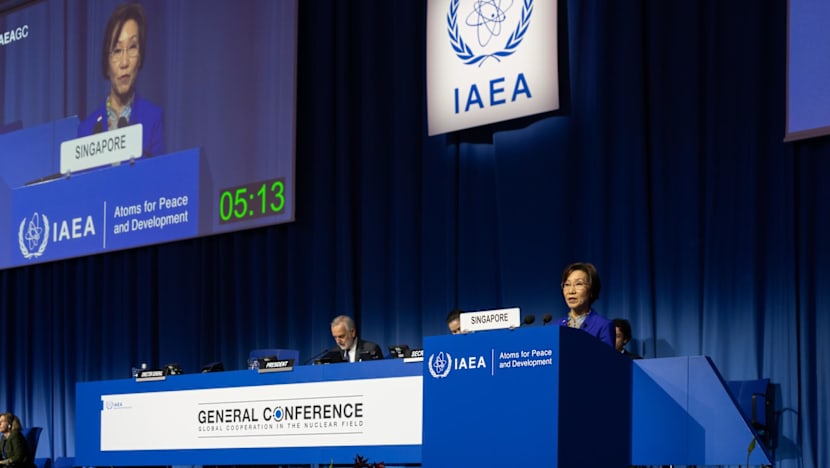
Singapore Opens Nuclear Readiness Review While Stressing Constraints
Singapore’s Minister for Sustainability and the Environment, Grace Fu, told the International Atomic Energy Agency (IAEA) General Conference in Vienna on Monday, September 14, that the city-state is approaching nuclear energy with an open mind while remaining acutely conscious of its limitations as a small, densely populated, and alternative energy-disadvantaged nation. Representing Singapore at the annual gathering of the UN’s nuclear watchdog, Ms Fu outlined a deliberate, phased strategy to build the institutional and technical capacity necessary to evaluate whether nuclear energy can realistically contribute to the country’s long-term climate and energy goals. No commitment to adoption has been made, but the process of structured assessment is now formally underway.
Central to Singapore’s approach is its planned participation in an Integrated Nuclear Infrastructure Review (INIR) with the IAEA, scheduled to begin in 2027. The INIR is a three-phase benchmarking process that will measure Singapore’s capabilities against the IAEA’s established milestones framework, identify gaps in expertise, institutions, and regulatory structures, and assess whether the country is positioned to make an informed decision on nuclear deployment. Ms Fu was explicit that the review does not constitute a commitment to adopt nuclear energy — rather, it is a diagnostic exercise designed to determine whether the prerequisite conditions for a credible decision even exist.
Building Institutional Capacity Across Government and Research
Before any deployment decision can be considered, Singapore has identified the need to develop robust scientific, technical, institutional, and regulatory capabilities capable of evaluating reactor technologies objectively. The government is advancing this agenda across multiple agencies, research institutions, and its regulatory system, while simultaneously deepening cooperation with nuclear regulators and international partners. Among the technologies under active study are small modular reactors (SMRs), which have attracted growing interest globally as a potentially more scalable and safer alternative to conventional large-scale nuclear plants — though their commercial viability at scale remains contested.
Ms Fu emphasised that the country’s approach will be “deliberate, structured, and rigorous,” with assessments spanning nuclear safety, security and safeguards, environmental sustainability, economic viability, public confidence, and Singapore’s international legal obligations. The sequencing of these criteria is significant: safety and public confidence appear alongside economic viability rather than subordinate to it, reflecting an institutional posture that acknowledges the political as well as technical dimensions of any eventual decision. Singapore’s dense urban geography and absence of geographic buffer zones make these considerations structurally more complex than in larger nuclear-adopting states.
Regional Cooperation and ASEAN Dimensions
Ms Fu signalled that regional cooperation will become increasingly important as interest in nuclear energy grows across Southeast Asia, and outlined a set of concrete commitments Singapore intends to pursue alongside ASEAN member states and the IAEA. These include strengthening emergency preparedness and response frameworks, operationalising regional protocols, expanding radiation monitoring networks, establishing information-sharing arrangements, and conducting joint readiness exercises. Singapore has also expressed support for the proposed ASEAN-IAEA strategic partnership on nuclear energy, safety, and governance — a framework that, if realised, would provide the region with a more coherent institutional architecture for managing nuclear risks collectively.
Singapore’s broader engagement with nuclear science is not new. Since 2000, the country has partnered with the IAEA through the Singapore-IAEA Third Country Training Programme, sharing expertise across nuclear medicine, radiotherapy, radiation protection, accelerator applications, radiochemistry, environmental monitoring, and climate-related measurements. Ms Fu reaffirmed Singapore’s financial commitment to the IAEA’s Technical Cooperation Fund, pledging its full target share for 2027, and called on all member states to meet their contributions in full and on time — a pointed reminder that multilateral nuclear governance depends on consistent funding from its members.
Geopolitical Concerns: Ukraine, Iran, and North Korea
Beyond the domestic energy calculus, Ms Fu used the Vienna platform to register Singapore’s concerns on several active geopolitical fault lines in nuclear governance. She described Singapore as “gravely concerned” over nuclear safety and security risks arising from the conflicts in Ukraine and the Middle East, warning that any attack on nuclear power plants poses significant and undeniable dangers. She urged all parties to respect what she termed the seven indispensable pillars of nuclear safety — a reference to the IAEA’s framework for protecting nuclear facilities during armed conflict.
On Iran, Ms Fu noted Singapore’s concern over unresolved questions surrounding the country’s compliance with its legally binding safeguards obligations, stating that any unaccounted-for nuclear material constitutes a proliferation risk. Regarding North Korea, she expressed continued concern over what she characterised as the “unconstrained development” of its nuclear weapons and ballistic missile programmes, citing the considerable risks these pose to regional and global peace, security, and stability. As Singapore prepares to assume the ASEAN chairmanship in January 2027, Ms Fu indicated the country intends to use that platform to advance regional and international cooperation on the safe, secure, and peaceful uses of nuclear technology.



