
BRICS Summit in New Delhi: War, Rivalry, and the Limits of Multilateral Consensus

Consensus, at this scale, is never clean.
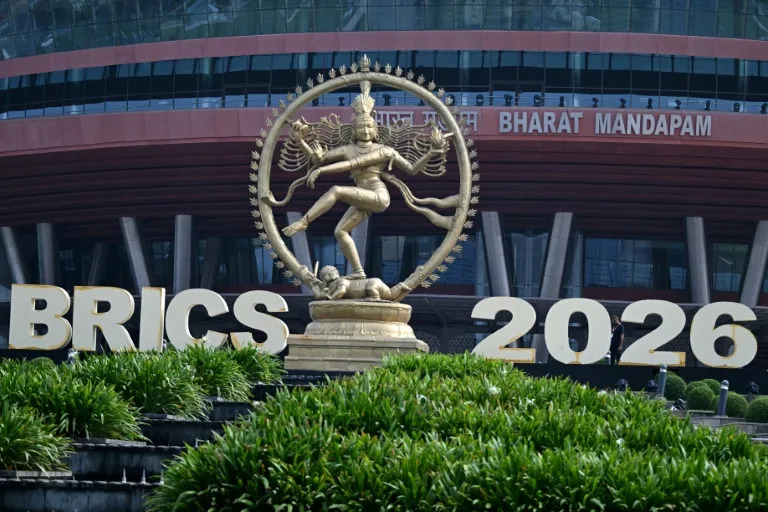
The eleventh iteration of the BRICS grouping convened in New Delhi on Saturday under conditions that tested the bloc’s foundational premise — that major emerging economies can coordinate meaningfully across deep ideological and strategic fault lines. They managed, just, to issue a joint statement on the Middle East, calling for “maximum restraint” and urging all parties to avoid actions that could “further aggravate the situation.” That this happened at all, after foreign ministers failed to agree on equivalent language in May, reflects how much diplomatic capital India invested in making the summit appear coherent.
The war that prompted the statement began with US-Israeli strikes on February 28th, drawing Iran directly into open conflict and fracturing the bloc’s earlier attempts at a unified position. Iran, Saudi Arabia, and the United Arab Emirates — all now BRICS members following the 2024 expansion — arrived in New Delhi with divergent threat perceptions and interests. That they signed the same document is a function of Indian mediation, not genuine convergence. The statement’s language is deliberately non-binding, calibrated to offend no one and commit everyone to nothing enforceable.
Indian Prime Minister Narendra Modi framed the summit’s ambition in terms that were simultaneously expansive and strategically vague, telling assembled leaders that BRICS nations collectively represent fifty percent of the world’s population, forty percent of global GDP, and more than a quarter of global trade, and calling for a transformation of what he described as a “pyramid of privilege” into a “platform of partnership.” The rhetoric is familiar, but the structural challenge it gestures toward — reforming Western-dominated financial and governance institutions — remains as distant as ever, not least because BRICS members themselves disagree on what reform should look like and who should lead it.
The summit’s most analytically significant dimension, however, is bilateral rather than multilateral. Xi Jinping’s presence in New Delhi marks his first visit to India since 2019, and the most consequential moment yet in what both governments have carefully described as a cautious normalisation. The two leaders met on the summit sidelines, though Beijing’s state broadcaster offered no substantive detail. What is known is the architecture of the thaw: restored direct flights, resumed visa processing, incremental high-level contacts — all following the deadly 2020 military clash along the disputed Tibetan border, a confrontation that froze relations for half a decade.
The structural constraints on that relationship have not changed. A roughly 3,500-kilometre high-altitude frontier with Tibet remains contested and heavily militarised on both sides. India’s trade deficit with China continues to widen. Strategic rivalry, particularly in the Indian Ocean and across Southeast Asia, persists beneath the diplomatic surface. Pradeep Taneja, a China-India specialist at the University of Melbourne, noted that both sides are seeking an “early and substantial harvest” on the border issue, while acknowledging the fundamental contradiction in maintaining massive force deployments along a frontier while simultaneously expanding people-to-people and economic ties. The contradiction does not resolve easily; it is managed, not solved.
Beijing’s pre-summit statement — that it was “ready to work with India by strengthening communication, enhancing cooperation, and properly handling differences” — is the language of controlled engagement rather than genuine rapprochement. Dozens of Tibetan exiles protested in New Delhi on Friday, waving placards against Xi’s visit, a reminder that the political geography of the relationship extends well beyond the negotiating table. The Dalai Lama has lived in India since 1959; his presence, like the border dispute itself, is a permanent structural fact that no bilateral communiqué can dissolve.
India’s own positioning at this summit is, characteristically, calibrated to multiple audiences simultaneously. New Delhi maintains working relationships with Tehran and Jerusalem, imports Russian oil despite sustained Western pressure, and simultaneously courts Washington as a strategic partner. Modi’s embrace of Vladimir Putin on Friday — Putin’s first visit to India since December 2025 — underscores how deliberately India has insulated its energy and defence relationships from Western-imposed frameworks. That insulation has a cost, measured in diplomatic friction, but it also reflects a strategic autonomy that New Delhi regards as non-negotiable. The BRICS summit, in this sense, is less a forum for collective action than a stage on which India performs its refusal to be fully aligned with any single power bloc — and does so, on this occasion, as host.