

Singapore’s Bicycle Rental Shops Face Structural Reckoning as Bike-Sharing Reshapes the Market

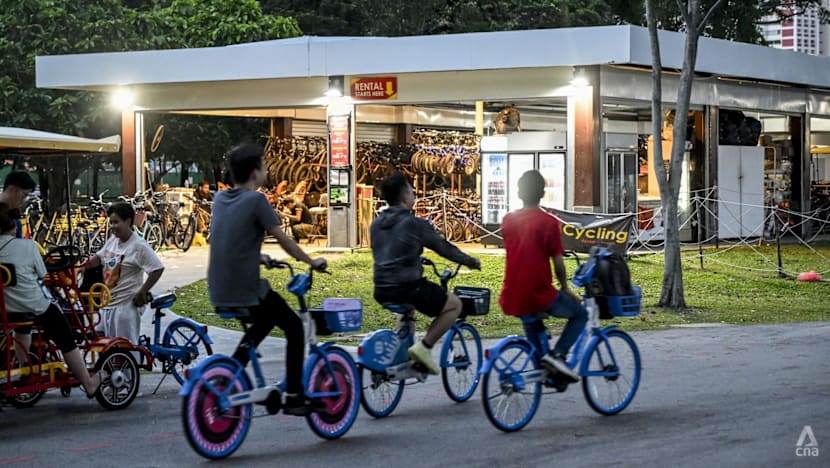
The central thesis here is uncomfortable but clear: Singapore’s traditional bicycle rental shops are not simply losing market share to a cheaper competitor — they are confronting a structural obsolescence that price adjustments and weekend events cannot fully reverse. What bike-sharing operators Anywheel and HelloRide have done is not merely undercut a price point; they have dismantled the economic logic on which the rental shop model was built.
Before the pandemic, Joe Chua’s Jomando shop at Punggol Beach operated with queues so long he marked waiting boxes on the floor with black tape. Customers were not just waiting to rent — they were waiting for bicycles to be returned. Today, roughly 200 bicycles sit idle in that same space, the tape slowly peeling off the floor. Chua estimates rental demand has fallen 80 to 90 per cent. He has surrendered one of two adjoining units, sold off around 100 bicycles, and now runs the operation alone. By his own account, he has absorbed losses of approximately S$250,000, drawing on personal funds to cover rent. On most weekends, he earns under S$600.
The arithmetic is not subtle. Renting from Jomando costs around S$10 per hour. Anywheel charges S$2 for the same duration; HelloRide charges S$2.50. That is not a marginal price difference — it is a structural one, and it reflects something deeper than competitive pricing strategy.
The Cost Structure Problem
Associate Professor Walter Theseira of the Singapore University of Social Sciences frames the issue precisely: traditional rental shops carry a legacy cost structure — physical premises, staffing, fleet maintenance, insurance — that dockless operators do not bear in the same configuration. The dockless model, for all its early chaos under oBike, Ofo and Mobike, proved one durable thing: that sufficiently lowering transaction costs could unlock demand well beyond the tourist-and-recreational-cyclist base that rental shops had historically served. When those early operators collapsed around 2019, rental shops recovered briefly. The pandemic cycling boom then gave them a second wind. But Anywheel and HelloRide, operating with approximately 35,000 and 25,000 bicycles respectively across the island, have since expanded aggressively into parks, waterfront areas and residential estates — precisely the terrain where rental shops had retained their strongest foothold.
At East Coast Park and Changi Beach, CNA’s observations on three separate evenings found at least eight in ten cyclists using shared bicycles. GoCycling at East Coast Park reports a 50 per cent drop in business, with walk-in customers now renting almost exclusively tandem bicycles or quadricycles — products the app-based operators cannot yet replicate. That residual demand is real, but it is narrow.
The competitive logic that users articulate is equally telling. A 27-year-old marketing executive who recently tried HelloRide at East Coast Park noted that while bicycle quality was inconsistent — her boyfriend’s unit lacked basic features present on hers — the solution was frictionless: stop at the next parking zone and swap. That kind of flexibility is structurally impossible for a shop-based model. The rental shop’s value proposition — staff availability, immediate replacement, accountability — requires a customer to be physically proximate to the shop. Bike-sharing’s value proposition is precisely the opposite: it dissolves that dependency entirely.
Kamal Ishnin, owner of The Bicycle Hut along North Bridge Road, derives roughly 80 per cent of revenue from rentals and has seen that customer base fall by 35 per cent. He is candid about what 2025 represents for his business: “This year is the deciding year on whether we carry on or shut down.” He has pivoted towards guided tours and corporate events, as has Chua — but both acknowledge the limits of that strategy. Walk-in volume cannot simply be replaced by B2B bookings, and the overhead structures remain largely fixed.
Premium as Survival Strategy
The more analytically interesting response to displacement is the premium repositioning pursued by Dualcircles, an appointment-based operator near Bishan that rents bicycles for 24-hour periods at prices ranging from S$30 to approximately S$400. Owner Jasper Guo has watched entry-level demand evaporate — budget customers have migrated wholesale to bike-sharing — and has responded by concentrating on high-performance road bikes sought by tourists completing the 80-kilometre round-island route. Roughly 80 per cent of his current customers are visiting cyclists seeking equipment that shared fleets cannot provide. He recorded a 40 per cent revenue loss in 2025, relocated from a larger unit in Toa Payoh, and let go of a full-time employee. Yet the strategic logic he is pursuing — personal inspection, curated fleet, experiential differentiation — is coherent in a way that competing on price against Anywheel is not.
Theseira’s framing applies here too: rental shops “can attempt to capture a higher end of the market … but they can’t compete anymore with just the same kind of bikes as dockless can provide with less overhead.” The premium segment is real, but it is inherently limited in scale. Singapore’s cycling population is not large enough to sustain multiple operators at that tier, and the tourist dependency Guo describes introduces its own volatility.
Academic observers broadly agree that the sector faces structural contraction over the next five to ten years unless operators move away from purely transactional, walk-in models. Dr Lynda Wee of NTU’s Nanyang Business School points to subscription models, formal membership tiers and digital appointment systems as viable pivots. Associate Professor George Wong of SMU identifies geographic niches — Pulau Ubin remains notably absent from bike-sharing networks — and lifestyle-community models as potential anchors. The helmet provision gap is also worth noting: rental shops can and do provide helmets with every bicycle, a safety differentiation that dockless operators structurally cannot match at scale.
None of these interventions reverse the underlying dynamic. What they potentially do is carve out defensible positions within a market that has fundamentally shifted. Singapore’s regulatory environment has, so far, allowed bike-sharing operators to expand without the kind of geographic or pricing constraints that might have preserved more space for traditional operators. The Land Transport Authority’s managed approach to shared mobility — licensing operators, designating parking zones, expanding park connector infrastructure — has prioritised network utility and commuter convenience. That is a coherent policy choice, but its distributional consequence is the slow erosion of a small-business ecosystem that predates the app economy by decades. The black tape on Jomando’s floor is not just peeling. It is, in a precise sense, a policy artefact.