

Singapore’s National Space Agency Charts an Ambitious Operational Roadmap — But the Hard Work Lies Ahead

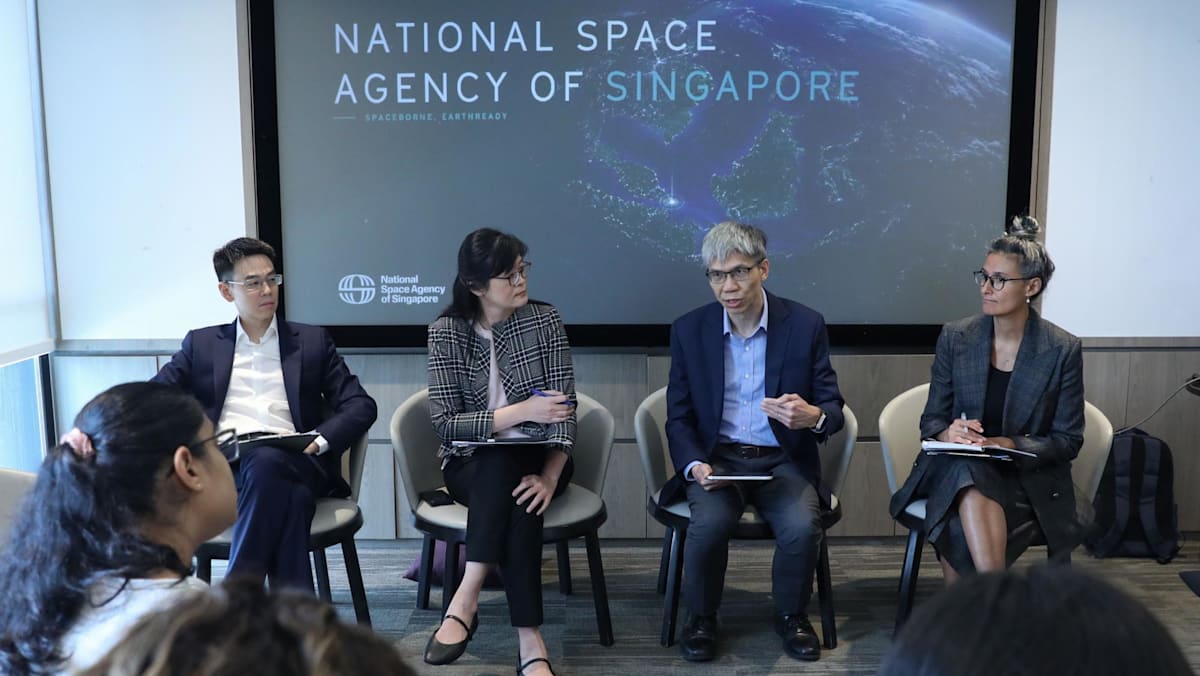
Singapore’s National Space Agency (NSAS) has laid out a concrete institutional agenda since beginning operations on 1 April 2025, and the centrepiece of that agenda is a national satellite mission operations centre scheduled to be functional by the first half of 2027. The thesis here is straightforward but worth stating precisely: NSAS is not merely a coordination body — it is being constructed as a full-spectrum space authority, one that will consolidate mission planning, situational awareness, regulatory oversight, and inter-agency integration under a single institutional roof. Whether that ambition can be executed within Singapore’s characteristically disciplined policy timelines remains the operative question.
From Procurement to Command
Singapore currently operates three Earth observation satellites co-owned by the government and ST Engineering, launched between 2022 and 2023. These assets serve a practical range of national functions — disaster response, marine pollution monitoring, maritime security, coastal infrastructure assessment, and urban planning. Until now, however, the operational logic governing these satellites has been distributed across agencies rather than centralised. The new operations centre changes that architecture fundamentally. It will serve as the single point from which NSAS plans and tasks national satellite missions, consolidating what has been a fragmented command structure into a unified platform.
Equally significant is the centre’s planned space situational awareness (SSA) capability. Singapore currently purchases SSA data from commercial providers — a dependency that carries both financial and strategic vulnerabilities. NSAS chief executive Ngiam Le Na noted that the number of satellites in low Earth orbit stands at approximately 11,000 as of 2024, and is projected to increase tenfold by 2035. As orbital congestion intensifies, so does the risk of debris collisions. Building indigenous SSA capacity is therefore not an aspirational upgrade — it is a risk management imperative. The centre will also host a multi-agency coordination platform, designed to make satellite-derived intelligence accessible across government in a structured, systematic way.
The Integration Challenge
NSAS deputy chief executive and chief technology officer Dr Desmond Lim was candid about the current state of inter-agency awareness: there is, he acknowledged, “less awareness of how space could actually impact their operations” among government agencies. This is a revealing admission. Singapore’s bureaucratic machinery is sophisticated, but satellite technology’s operational utility is not self-evident to agencies whose workflows were designed without it. NSAS is presently in active discussions with those agencies to define their requirements and map out viable use cases, with potential focus areas including Earth observation, geospatial analytics, maritime and aviation incident management, and urban planning.
One technically significant capability under consideration is Interferometric Synthetic Aperture Radar (InSAR), which measures land surface changes with millimetre precision. Dr Lim highlighted its applicability to tracking land subsidence, coastal encroachment, and forest growth — all of which carry direct policy relevance for a land-scarce, low-lying island state. The broader point is that NSAS is not simply matching existing agency demands to satellite products; it is in the more complex business of reshaping agency workflows to accommodate capabilities those agencies have not yet learned to want. That is an institutional change management exercise as much as a technical one.
Regulatory Architecture and Constellation Renewal
NSAS is also developing Singapore’s first national space legislation. The law, led by chief strategy and policy officer Tiana Desker, will focus on two pillars: space safety — managing collision risks in an increasingly congested orbital environment — and space sustainability, meaning responsible practices to prevent the creation of additional debris. Practically, this could translate into requirements for satellite operators to submit credible deorbiting plans, including launching into orbits low enough for natural atmospheric decay. A national registry of Singapore space objects, consistent with international norms, is also planned. Together, these measures position Singapore as a rule-setter rather than merely a rule-follower in the emerging global governance of outer space.
On the constellation itself, the three active satellites face replacement by 2029 to 2030, given a typical operational lifespan of five to seven years. Dr Lim indicated that NSAS has a working estimate of future satellite requirements, though the final number will be shaped by advances in commercial technology and shifts in government budget and operational priorities. Singapore’s space sector currently employs around 2,000 professionals across 70 companies, and NSAS sees talent pipelines extending across mechanical, electrical, and systems engineering, artificial intelligence, and domain specialists in fields such as urban planning who can translate satellite data into actionable sectoral insights.
The Institutional Wager
What NSAS is attempting is less a launch and more a consolidation — bringing under one institutional authority the operational, regulatory, and strategic dimensions of a national space programme that has until now been assembled piecemeal. The 2027 deadline for the operations centre is the near-term test of that consolidation. Singapore’s track record in executing complex infrastructure and regulatory projects on schedule is strong, but the inter-agency integration challenge that Dr Lim flagged is precisely the kind of soft coordination problem that timetables alone cannot solve. The agency’s real measure of success will not be the opening of a new headquarters, wherever that undisclosed location turns out to be — it will be whether satellite intelligence is genuinely embedded in how Singapore’s agencies plan, respond, and govern by the end of this decade.