
ASEAN Foreign Ministers Claim Progress on South China Sea Code of Conduct, Set Year-End Deadline

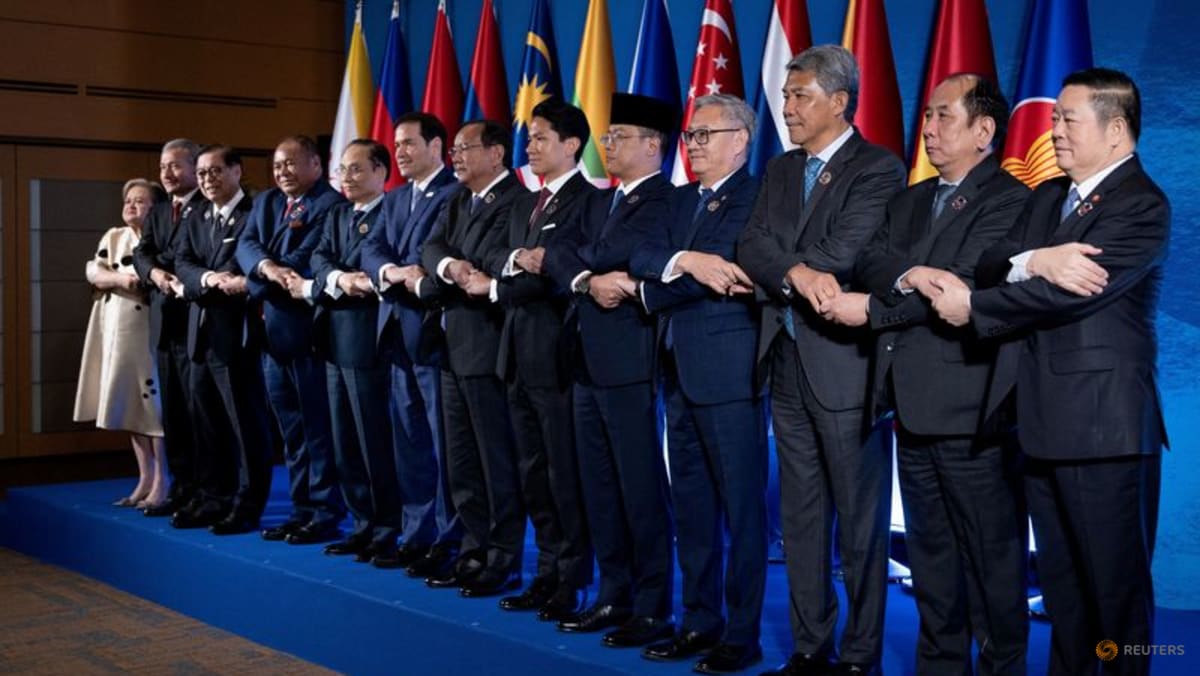
ASEAN foreign ministers declared “significant progress” in negotiations on a long-awaited Code of Conduct (COC) for the South China Sea at their 59th Foreign Ministers’ Meeting in Manila on Friday, 25 July, expressing collective hope that talks could be concluded before the end of 2025 — even as fresh confrontations between the Philippines and China cast doubt on the diplomatic optimism.
A Deadline Stated, A Gap Acknowledged
The meeting, hosted by the Philippines as current ASEAN chair, produced a joint communiqué reaffirming the bloc’s commitment to peace, stability, and freedom of navigation in the contested waterway. Ministers said they were “pleased with the sustained positive momentum” in ongoing negotiations and welcomed “the significant progress achieved so far.” The communiqué explicitly called for efforts to “conclude the negotiation of an effective and substantive COC that is in accordance with international law, including the 1982 UNCLOS, within this year.” That language is notably more time-bound than previous iterations of ASEAN’s standard South China Sea boilerplate.
Philippine Foreign Affairs Secretary Maria Theresa Lazaro, whose country chairs ASEAN this year, told reporters on the sidelines that the intensified pace of negotiations reflected genuine political will across member states and China alike. “This seems to be the focus of many of the countries, and I can see some political will from all the countries involved,” she said. She also confirmed that the latest incidents near Second Thomas Shoal and Scarborough Shoal — where Manila and Beijing have traded accusations over separate confrontations — would form part of ongoing COC discussions.
Analysts, however, were measured in their assessment. Andreyka Natalegawa, associate fellow at the Center for Strategic and International Studies’ Southeast Asia Program in Washington, noted that these negotiations have been “quite thorny” for decades. “Look at the political realities of what we’re seeing in the waters of the South China Sea — it feels as though a conclusion to the Code of Conduct negotiations seems quite challenging,” he told CNA’s Asia First. The gap between diplomatic language and operational reality in the South China Sea remains, by any honest accounting, substantial.
Maritime Instability Beyond Southeast Asia
The South China Sea was not the only maritime flashpoint on the agenda. ASEAN foreign ministers also raised concerns over the Strait of Hormuz, where months of instability have disrupted global shipping lanes and energy supply chains with direct consequences for Southeast Asian economies. Singapore’s Foreign Affairs Minister Vivian Balakrishnan framed the issue in terms that resonate acutely for a trade-dependent region: recent escalations in the strait, alongside attacks on Saudi tankers in the Red Sea, have exposed the fragility of supply chains that underpin ASEAN’s energy, fertiliser, and food imports.
“Everyone doubled down on the need to comply with international law, maintain the primacy of international law, and uphold freedom of navigation and overflight,” Dr Balakrishnan said, characterising the ministers’ consensus as firm. The language mirrors what ASEAN applies to the South China Sea — a consistent institutional reflex toward rules-based framing, whatever the specific geography. Whether that consensus translates into coordinated action remains a different question entirely.
Myanmar: The Bloc’s Unresolved Crisis
Myanmar retained its place on the agenda, as it has at virtually every major ASEAN gathering since the February 2021 military coup. The bloc’s Five-Point Consensus — calling for an immediate cessation of violence, constructive dialogue among all parties, the appointment of a special envoy, humanitarian assistance, and envoy access to all concerned parties — was reaffirmed as ASEAN’s primary framework, even as its implementation has remained largely symbolic in the years since its adoption.
Thailand recently proposed that access to Aung San Suu Kyi, detained since the coup, be included among the benchmarks used to assess Myanmar’s compliance with the Five-Point Consensus. Dr Balakrishnan pushed back on any transactional framing of that proposal. He stressed that Aung San Suu Kyi should not be treated as “a chip to be bargained over,” and that any shift in ASEAN’s engagement posture must be anchored in measurable, verifiable progress on the ground. He also emphasised that humanitarian assistance must reach all affected populations without political filtering — a pointed reference to the junta’s documented practice of restricting aid flows along factional lines.
Among the structural reforms under discussion was the replacement of the current one-year rotating special envoy arrangement with a long-term appointment, a change that would provide greater continuity and institutional memory in ASEAN’s engagement with Naypyidaw. Lazaro, who currently serves as ASEAN special envoy to Myanmar in addition to her role as Philippine foreign secretary, is scheduled to visit the country in the final quarter of the year. The proposals build on informal consultations held in Bangkok on 12 July, where member states explored ways to strengthen the bloc’s leverage — limited as it has proven to be — over a military government that has shown little appetite for compromise.