Christopher Nolan’s The Odyssey Opens to US$264 Million Globally, Cementing His Box Office Authority

A Director’s Brand as Commercial Infrastructure
Christopher Nolan’s adaptation of The Odyssey grossed US$264.1 million (S$341.2 million) in worldwide ticket sales during its opening weekend, with US$124.5 million of that figure coming from North America alone, Universal Pictures confirmed on Sunday, 19 July. The result positions the film as one of Nolan’s strongest commercial launches to date — and it advances a thesis worth examining closely: in an era of franchise fatigue and streaming attrition, a single filmmaker’s name has become one of the most reliable demand-generation mechanisms in the theatrical exhibition business.
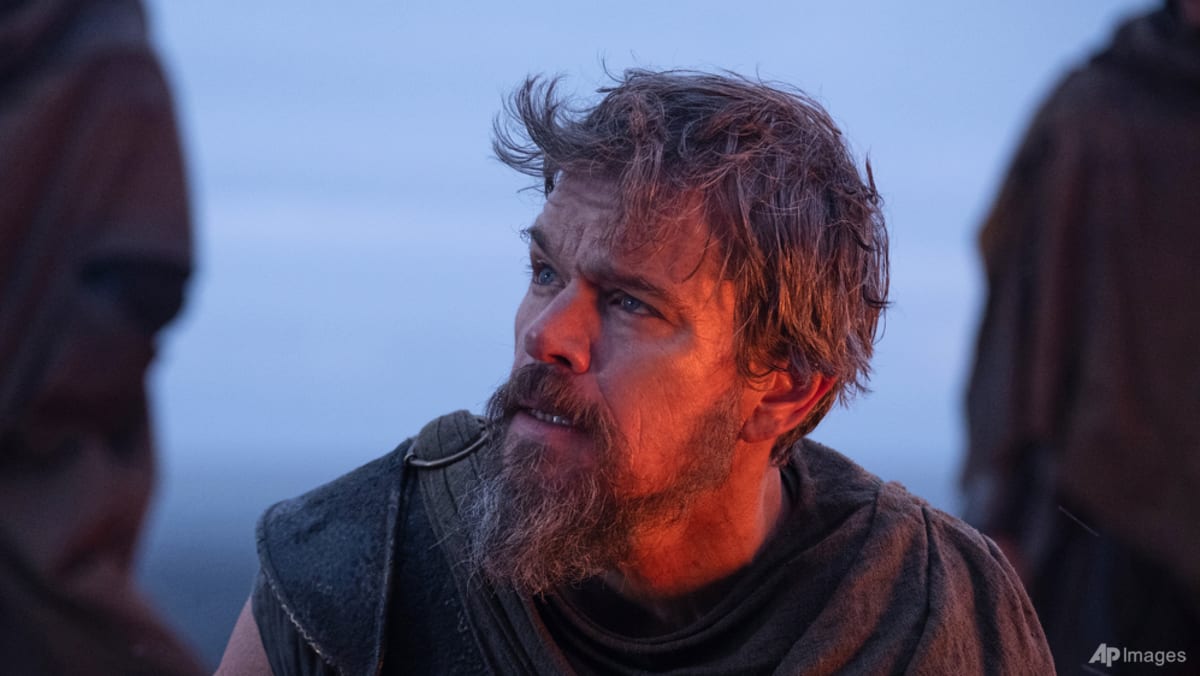
The film stars Matt Damon as Odysseus, the Greek hero navigating a perilous journey homeward after the Trojan War, drawing from Homer’s epic poem believed by most scholars to have been composed orally in the seventh or eighth century BC before being committed to writing. Nolan’s adaptation centres on a portion of that homecoming — encounters with gods, monsters, storms and tragedy — rendered through IMAX cameras and 70mm film stock. It is his first feature since Oppenheimer in 2023, which collected Academy Awards in multiple categories including Best Picture and Best Director. The gap between releases, rather than diluting anticipation, appears to have concentrated it.
The Numbers in Context
The US$264.1 million opening represents a substantial return against a reported production budget of US$250 million, though theatrical economics require global grosses to scale considerably beyond production costs before a studio achieves profitability once marketing expenditure and exhibitor revenue-sharing are factored in. Still, the opening weekend figure establishes strong commercial momentum. Adjusted for inflation, The Odyssey ranks as Nolan’s third-highest global opening, behind The Dark Knight Rises (2012) at an inflation-adjusted US$358.5 million and The Dark Knight (2008) at US$304 million — both entries in a pre-existing franchise with decades of cultural equity behind them. That a wholly original literary adaptation, however ancient its source material, performs at comparable scale is a structurally significant data point.
Audience composition reinforces the reading. Universal’s president of theatrical distribution in North America, Jim Orr, noted that half of all ticket-buyers fell between the ages of 18 and 34 — a demographic that streaming platforms have spent years attempting to capture and retain. The film received an A CinemaScore from opening-night attendees and a 97 per cent audience rating on Rotten Tomatoes, metrics that suggest word-of-mouth will sustain the theatrical run beyond its launch weekend rather than cannibalise it through early negative sentiment.
IMAX as a Premium Demand Signal
The premium format dimension of this opening deserves particular scrutiny. Half of all North American ticket-buyers chose an enhanced viewing format, with IMAX accounting for 23 per cent of that share — a figure that speaks both to Nolan’s well-documented commitment to large-format filmmaking and to the audience’s willingness to pay a price premium for the experience he designs around it. IMAX CEO Richard Gelfond disclosed that the company recorded US$50 million in advance ticket sales ahead of the opening, describing it as the strongest presales performance in IMAX’s history. Demand was so acute that more than 50 North American theatres added screenings between midnight and 7am to absorb it. Tickets at select IMAX venues had gone on sale a full year before the film’s release.
This dynamic illustrates a broader structural reality in theatrical exhibition: premium large format screens have become the industry’s most effective tool for differentiating cinema from home viewing, and Nolan’s films function as the clearest proof-of-concept for that proposition. When Gelfond describes The Odyssey as “almost perfectly made — in many respects,” he is not simply offering a critical assessment; he is articulating the commercial logic that justifies IMAX’s infrastructure investment and expansion strategy.
What the Opening Actually Proves
Paul Dergarabedian, head of marketplace trends at Rentrak, observed that “modern audiences should not be underestimated on their knowledge of film and filmmakers,” pointing to the audience’s devotion to Nolan as a measurable market force. That observation carries more analytical weight than it might initially appear. The conventional wisdom in Hollywood holds that intellectual property — sequels, franchises, recognisable characters — is the primary driver of opening-weekend performance. Nolan’s track record complicates that assumption systematically. Oppenheimer, a three-hour biographical drama about a nuclear physicist, grossed over US$950 million globally. The Odyssey, an adaptation of a Bronze Age Greek poem, opens to US$264 million in a single weekend.
The implication is not that intellectual property no longer matters — it plainly does — but that directorial authorship, at sufficient scale and with sufficient consistency, constitutes its own form of intellectual property. Nolan has built an audience that trusts his formal ambitions and turns up accordingly, regardless of subject matter. For an industry still negotiating its structural relationship with streaming, that is a commercially meaningful and institutionally instructive precedent.