
Singapore’s Non-Oil Exports Surge 20.7% in June, Powered Almost Entirely by AI-Driven Electronics Demand

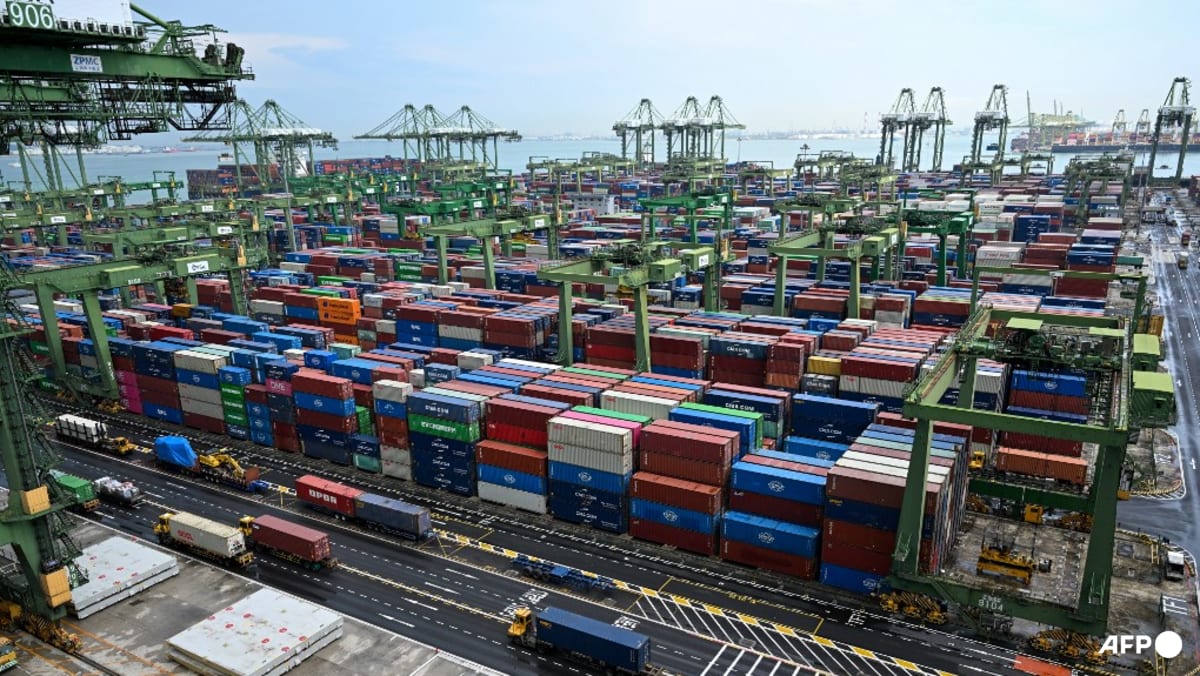
The numbers are striking. Singapore’s non-oil domestic exports climbed 20.7 per cent year on year in June 2025, and behind that headline figure lies a story that is both impressive and structurally narrow — one where a single sector is doing the heavy lifting for the entire economy’s export performance.
Enterprise Singapore released the data on Friday, 17 July, confirming that electronic NODX surged by 105.1 per cent in June, accelerating from the already formidable 94.8 per cent expansion recorded in May. The agency attributed the surge explicitly to robust AI-related demand, concentrated in three product categories: integrated circuits, disk media products, and personal computers. Integrated circuits alone rose 115.4 per cent year on year. Disk media products — the storage infrastructure underpinning AI data centres — climbed 170.9 per cent. PCs followed at 95.8 per cent. These are not marginal movements; they represent a structural reorientation of Singapore’s export flows around the global AI investment cycle.
Selena Ling, chief economist and head of OCBC Group Research, placed the figure in longer historical context, describing June’s electronics export growth as the strongest since 1998. That reference point matters. The late 1990s surge was driven by the tail end of a PC boom and early internet infrastructure build-out. Today’s driver is categorically different in scale and capital intensity — hyperscaler investment in AI compute infrastructure, with Singapore positioned as a critical node in the regional supply chain for the chips and storage hardware that underpin it.
Yet the composition of June’s NODX performance demands careful reading. Non-electronic exports contracted by 2.9 per cent, reversing May’s 17.7 per cent gain. Non-monetary gold, petrochemicals, and food preparations all declined. Ling was direct about what this means: “The resilient June NODX was single-handedly powered by electronics exports due to the AI boom.” That is not a criticism so much as a structural observation — and one that carries implicit risk. An export profile this dependent on a single demand cycle, however powerful, concentrates vulnerability in ways that broader diversification would not.
The wider trade picture reinforced the electronics-led narrative. Non-oil re-exports rose 60.3 per cent in June, extending May’s 33.5 per cent increase, again driven primarily by electronics. Total merchandise trade expanded 49.3 per cent, with total exports up 48.9 per cent and imports growing 49.8 per cent. In absolute terms, Singapore’s total trade stood at S$158.1 billion in June — S$85.5 billion in exports against S$72.6 billion in imports.
Geographically, the demand signal was unusually broad. NODX to all of Singapore’s top ten markets rose in June, led by Taiwan, which posted triple-digit growth for the second consecutive month. Taiwan’s centrality here is not incidental — it reflects the island’s position as home to TSMC and the broader semiconductor fabrication ecosystem that feeds AI hardware globally. The United States and South Korea also recorded gains. Perhaps most telling was Indonesia, which eked out a 2.7 per cent expansion after a run of contractions. Ling characterised this as “tentative stabilisation in import demand,” noting that Indonesia’s NODX is concentrated in non-electronics — meaning its recovery is independent of the AI surge and potentially signals a modest broadening of demand conditions in the region.
On the forward outlook, OCBC now sees upside risk to its full-year 2026 NODX growth forecast of 6 per cent, given what Ling described as a “stellar” first-half performance. She acknowledged stock market volatility but argued that the underlying AI investment momentum retains near-term momentum. Even if growth moderates in the second half — a reasonable base case as base effects become more demanding — the directional picture remains constructive. The structural question, which the data does not yet answer, is whether Singapore’s electronics export surge reflects durable infrastructure investment or a front-loading of orders ahead of potential supply chain disruptions and tariff uncertainty. That distinction will matter considerably when the cycle eventually turns.
For now, the June figures confirm Singapore’s singular exposure to — and singular benefit from — the global AI capital expenditure wave. The city-state’s role as a conduit for advanced semiconductors and storage hardware has never been more economically legible. Whether that legibility translates into long-term industrial depth, or remains a transit premium on someone else’s technology cycle, is the harder question the data does not yet resolve.