
Maju Forest at a Crossroads: HDB’s Sunset Way Plans Reveal the Limits of Singapore’s Greenfield Dilemma

Singapore’s land constraints are real. So is the cost of ignoring them.
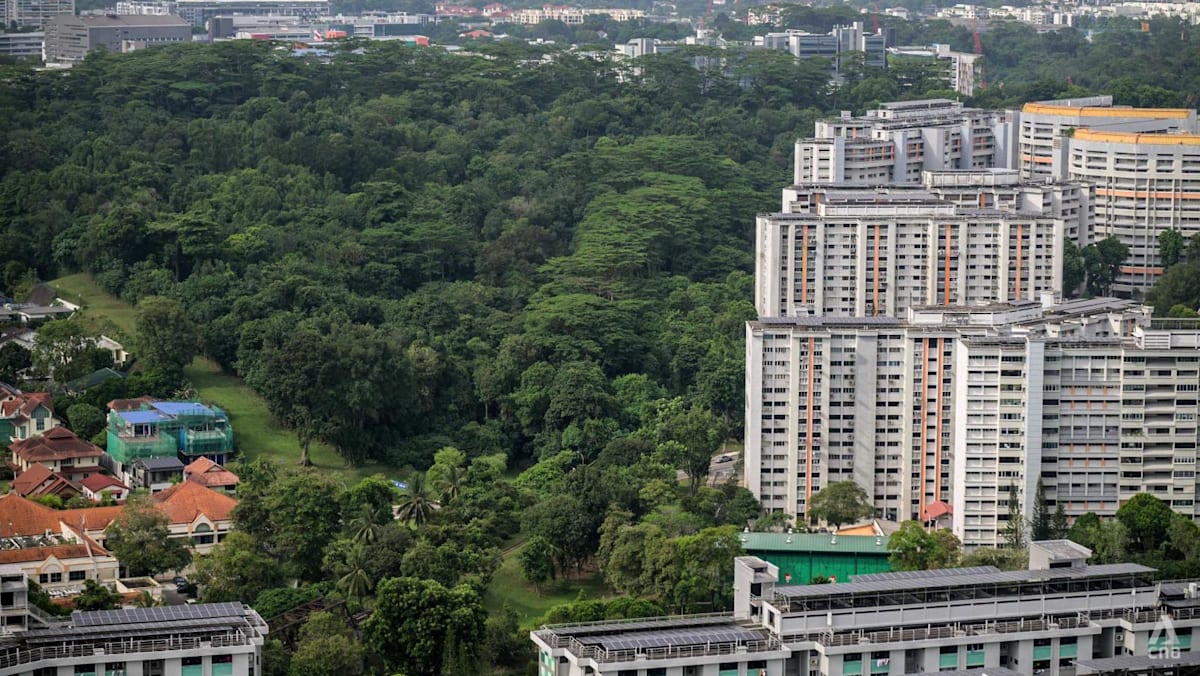
When the Housing and Development Board announced last week that Sunset Way — and with it, a significant portion of Maju Forest — would be developed for residential housing, it triggered something more than a neighbourhood dispute. It exposed a structural tension that Singapore’s urban planners have long managed through careful sequencing but have never fully resolved: the point at which housing demand exhausts the supply of politically acceptable brownfield sites and begins consuming green ones.
The central thesis here is not that HDB is wrong to consider Sunset Way, nor that residents are wrong to resist. It is that the agency’s own framing — “plans are not final,” “we remain open to feedback” — signals a genuine negotiation, not a public relations exercise. Whether that negotiation produces a meaningfully different outcome depends on whether the institutional process is designed to absorb dissent or merely to document it.
HDB’s chief town planner, Dr Chong Fook Loong, offered the clearest statement of the agency’s position when he cited the recent Clementi Build-to-Order exercise, which was oversubscribed by more than four times, as evidence of acute housing pressure in the western region. His reasoning was direct: brownfield sites in Clementi and its surrounds are nearly exhausted, which makes Sunset Way — a 23-hectare greenfield study area zoned for residential use since the 1980 master plan — the next logical candidate. Of that 23 hectares, approximately 8 hectares would be retained under current proposals, largely along the forest’s periphery. That is not trivial preservation, but it is also not the outcome that more than 17,000 petition signatories are asking for.
The petition, addressed to several government agencies, urges authorities to pause any forest clearance and redirect development pressure toward expiring golf courses and ageing industrial land. This is not an unreasonable position in principle. Singapore has used exactly this logic before — Tengah, Bidadari, and the ongoing redevelopment of former industrial zones all demonstrate that brownfield-first sequencing is institutionally viable. The question is whether sufficient brownfield capacity remains in the western corridor to absorb the demand that the Clementi BTO data makes concrete. HDB’s planners, who have access to the full pipeline of sites and projected household formation rates, are better positioned than petition organisers to answer that question. But they have not yet made that data publicly legible in a way that would allow residents to evaluate the trade-off on equal terms.
This asymmetry of information is where the engagement process becomes structurally significant. More than 100 residents attended Friday’s closed-door session at Bukit Timah Community Club, where Holland-Bukit Timah GRC MPs Christopher de Souza and Sim Ann were also present. Senior Minister of State Sim Ann acknowledged the range of concerns raised — loss of greenery, traffic congestion, construction noise — with the careful register of an official who understands that the session’s legitimacy depends on residents believing their input carries weight. The session ran for over two and a half hours. Residents who attended told CNA they left unsettled, hopeful but unconvinced.
The residents themselves are not a monolith, and that matters analytically. Among those CNA spoke to this week, the positions ranged considerably:
These are not merely anecdotes. They represent the genuine distribution of interests that HDB must navigate — and they complicate the narrative that positions this as a simple conflict between conservation and development. Singapore’s housing policy has never operated through consensus; it has operated through institutional authority calibrated by political sensitivity. The question is whether the feedback window, which closes on August 6, functions as a genuine input mechanism or as a legitimation ritual for a decision already substantially made.
Dr Chong’s repeated insistence that plans remain open carries more weight if read alongside HDB’s track record of modifying proposals in response to sustained public engagement — Bidadari’s heritage trees, for instance, were preserved after organised advocacy. It carries less weight if the Environmental Impact Assessment, which is guiding the Sunset Way development, has already fixed the parameters of what is ecologically negotiable. HDB has not yet published the full assessment, which limits the public’s ability to scrutinise its conclusions.
What the Sunset Way episode ultimately reveals is that Singapore’s soft-authoritarian planning model functions most smoothly when greenfield development remains an abstract future possibility rather than an immediate neighbourhood reality. The moment it becomes concrete — when residents can see the boundary of what will be cleared, when they can name the vultures that wintered in the canopy — the model’s legitimacy depends not on the quality of the outcome alone, but on the credibility of the process that produced it. HDB has signalled openness. The burden now is to demonstrate it.