

Holding the Line: How Indonesian Small Businesses Are Navigating Inflation, a Weakening Rupiah, and an Economy Under Strain

A 5,000-Rupiah Haircut in a City Where Everything Costs More
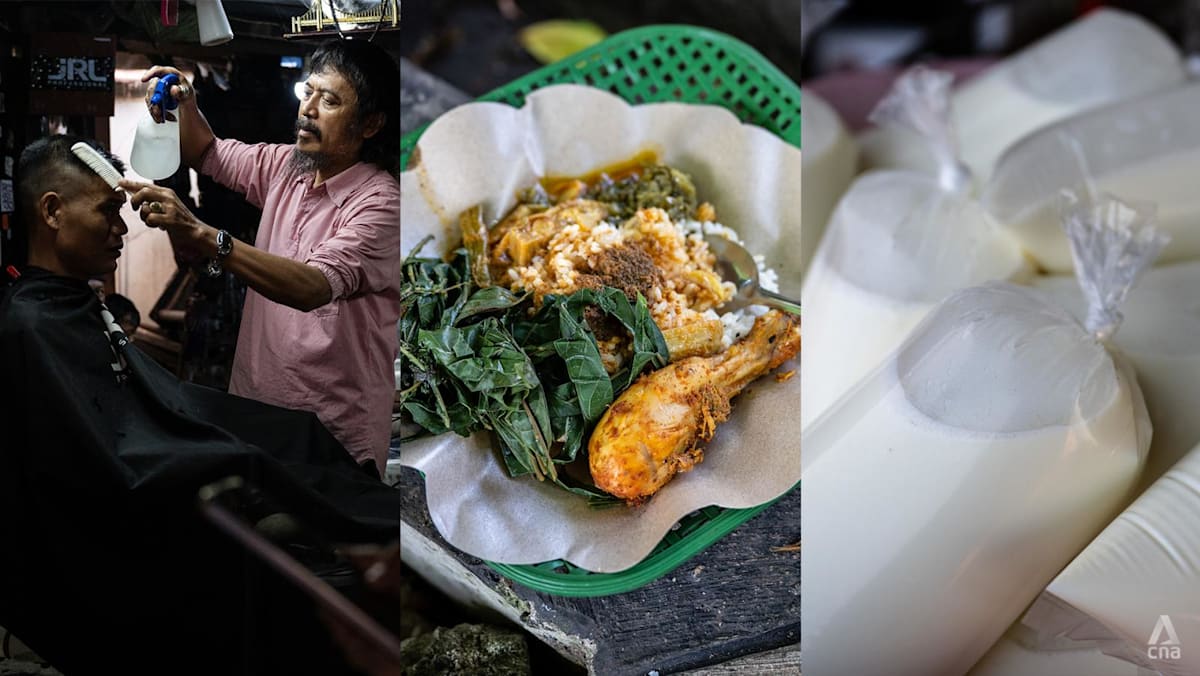
Supriyanto has not raised his prices since 2008. Inside Pemuda Barbershop — a weather-beaten hut on one of Bogor’s busiest streets, its zinc roof warping, its barber chairs broken, its walls layered with Javanese puppets and faded hairstyle posters — he charges 5,000 rupiah, roughly US$0.31, for a haircut. That is approximately one-third of what a working-class barbershop typically charges in Indonesia, and a tenth of the price at a middle-class salon.
Between 30 and 50 customers file through each day from 10am. They come for the skill. They come for the price. And they come because, as Supriyanto put it plainly: “I don’t have the heart to raise my prices. Where else will these people go?”
That question sits at the centre of a broader economic reckoning playing out across the Indonesian archipelago. A rupiah that has shed as much as 7.8 per cent of its value against the US dollar over the past year, energy costs elevated by the Middle East conflict, and surging raw material prices have compressed margins across the informal and formal sectors alike. Some businesses have absorbed the pain. Others have passed it on. The choices being made at the level of roadside stalls and backstreet barbershops reveal the fault lines of an economy under sustained pressure.
The Macroeconomic Pressure Behind Every Price Decision
The structural forces driving this inflation are neither local nor simple. On June 8, the rupiah hit a record low of 18,190 to the US dollar — far beyond the government’s 2026 budget assumption of 16,500. That depreciation compounds the effect of global commodity shocks, making imported inputs materially more expensive for manufacturers, food vendors, and livestock farmers alike.
Data from Indonesia’s Central Bank Strategic Food Price Information Centre illustrates the scale of the problem. Since the US-Iran conflict escalated in late February:
The pressure has not remained confined to food. Higher energy and raw material costs have contributed to factory closures and a significant wave of layoffs. According to the Ministry of Manpower, more than 43,000 workers lost their jobs between January and June 2025 — a 34 per cent increase compared to the same period in 2024. That figure, however, almost certainly understates the damage. The ministry does not systematically monitor the informal sector, which employs close to 60 per cent of Indonesia’s workforce according to the Indonesian Bureau of Statistics.
“This means the true figure is likely much higher because not all job losses are recorded,” said Achmad Nur Hidayat, an economist from Jakarta’s National Development University. The people most exposed to those unrecorded losses are precisely the customers keeping Supriyanto’s barber chairs occupied.
The Hard Choice: When Vendors Raise Prices
Not every business can hold the line. For many, the arithmetic simply does not work.
Susilowati, a 60-year-old catering operator in Jakarta, tried to absorb rising ingredient costs before concluding that the alternative — switching to cheaper inputs — would compromise the quality her clients paid for. She raised prices by up to 10 per cent. “It was a hard decision,” she told CNA. “We chose to raise prices” rather than degrade the product.
Satay vendor Mulyadi made a similar calculation at his roadside stall in Central Jakarta, adding 1,000 rupiah to every menu item. His chicken satay now costs 25,000 rupiah; goat satay, 29,000. Customers complained. He raised prices anyway. “If we don’t raise our prices, we’ll end up losing money,” he said, tending his charcoal grill. The logic is straightforward, even if the social cost is not.
These decisions ripple outward. Each price increase at the vendor level reduces the purchasing power of informal workers, domestic staff, and factory employees who rely on cheap street food as a daily caloric baseline. Indonesia defines poverty as earning less than 600,000 rupiah per month. For the 23 million people living below that threshold, a 1,000-rupiah increase on a satay skewer is not trivial.
The Counter-Strategy: Volume Over Margin
Feby Aulia operates her food stall, Duo Putri, from the back of a minivan parked along a roadside in Bogor. She sells nasi padang — rice accompanied by richly spiced meats, curries, and sambals drawn from West Sumatran culinary tradition. Her price: 12,000 rupiah for a basic meal, unchanged since 2022.
The trade-off is visible. Her beef rendang uses thinner cuts; her chicken curry uses drumsticks and wings rather than breast meat. Portions are modest compared to brick-and-mortar restaurants. But the price holds, and so do the customers. Office workers and department store clerks from surrounding buildings begin queuing before the stall opens at 11am. By 1pm, every dish has sold out.
“Many people depend on us for an affordable meal because everyone else around here has either raised their prices or reduced their portions,” Feby said. “We decided not to do either.” The decision has converted price restraint into a competitive advantage. Higher foot traffic has, she says, kept the business profitable despite tighter margins on each plate served.
Operating from a van rather than a fixed premises is central to that model. Feby pays only a sanitation fee and modest parking rent — a fraction of what a permanent shopfront would cost. The arrangement is efficient. It is also precarious. Regulatory changes or zoning decisions could force relocation, severing the geographic loyalty that sustains her lunch-hour queue.
Fresh Milk, Animal Feed, and the Limits of Goodwill
Koharuddin, 67, sells fresh milk from his single-storey home on the outskirts of Jakarta. At 12,000 rupiah per litre — roughly half the price of established commercial brands — he has not changed his price in five years. The arithmetic behind that decision is partly social, partly commercial.
Fresh milk occupies a discretionary position in many Indonesian household budgets. A price increase, Koharuddin reasons, could suppress demand enough to leave him with unsold inventory. “I’d rather sell milk cheaply and make a small profit than let it all go to waste,” he said. But the costs pressing against that position are intensifying. Animal feed, supplements, and vitamins have all risen sharply, driven by the same rupiah depreciation affecting every import-dependent input. Livestock farmers have passed those costs up the chain to vendors like him. How long the 12,000-rupiah price holds is an open question.
Government Response: Stimulus, School Meals, and Structural Gaps
Jakarta has not been passive. Bank Indonesia has raised interest rates in an attempt to stabilise the rupiah. The government has deployed a 26.3 trillion rupiah stimulus package for the second half of 2026, incorporating food assistance, transport incentives, and temporary employment programmes. President Prabowo Subianto’s flagship free nutritious meal programme — providing one meal per day to millions of schoolchildren at a cost of roughly 1 trillion rupiah daily — has had the incidental effect of easing food prices during school holidays, as supplies originally earmarked for the programme enter the broader market.
Economists, however, have questioned whether these measures are calibrated to the scale of the problem. The rupiah’s weakness reflects deeper concerns about investor confidence and policy predictability, not merely short-term liquidity conditions.
“The government needs to establish policy certainty and improve ease of doing business to attract more job-creating investments,” said Bhima Yudhistira, executive director of the Centre of Economic and Law Studies (CELIOS). Without that structural foundation, stimulus packages address symptoms while the underlying vulnerability persists.
The US-Iran interim accord signed last month, a 14-point agreement aimed at halting Middle East hostilities and reopening the Strait of Hormuz — through which approximately one-fifth of the world’s oil supply passes — offered a potential pathway to energy price stabilisation. But the ceasefire has remained fragile, with sporadic clashes continuing. The rupiah has shown little sign of recovery. For Indonesian businesses dependent on imported inputs, the relief has not materialised in any meaningful way.
The Philosophy Behind the Price
Supriyanto did not start out serving working-class customers. When he migrated from Central Java to Bogor in 1988 to open his first barbershop, he targeted the middle market. The shop offered air conditioning, complimentary drinks, head massages, and charged 2,500 rupiah per haircut — reasonable for its segment at the time.
Then a realisation shifted everything. “What I charged for one haircut was what some families spent on food for an entire day,” he said. He reoriented the business toward ordinary working people. Nearly four decades later, the logic has not changed, even as the economic pressures around it have intensified.
His two largest fixed costs — 2 million rupiah monthly in rent and roughly 1 million rupiah in wages for a freelance second barber — have remained stable, which is why the 5,000-rupiah price remains viable. He has adjusted elsewhere. “Less eating chicken and more eggs,” he said with a bitter smile. But the price on the wall stays where it is.
The land beneath Pemuda Barbershop is now for sale. The neighbourhood has become more valuable, and a new owner could force Supriyanto out of the modest wooden hut he has occupied for decades. Whatever the outcome, he is clear about his intentions. “If I can still make an honest living while helping people save a little money, that’s enough for me.”
That is not naivety. It is a considered position, held under genuine financial pressure, by someone who has watched the economy move around him for nearly forty years without abandoning the customers it has repeatedly left behind.