

India Must Scale Space Ambitions Beyond Showcase Missions, Experts Warn

India Must Scale Space Ambitions Beyond Showcase Missions, Experts Warn
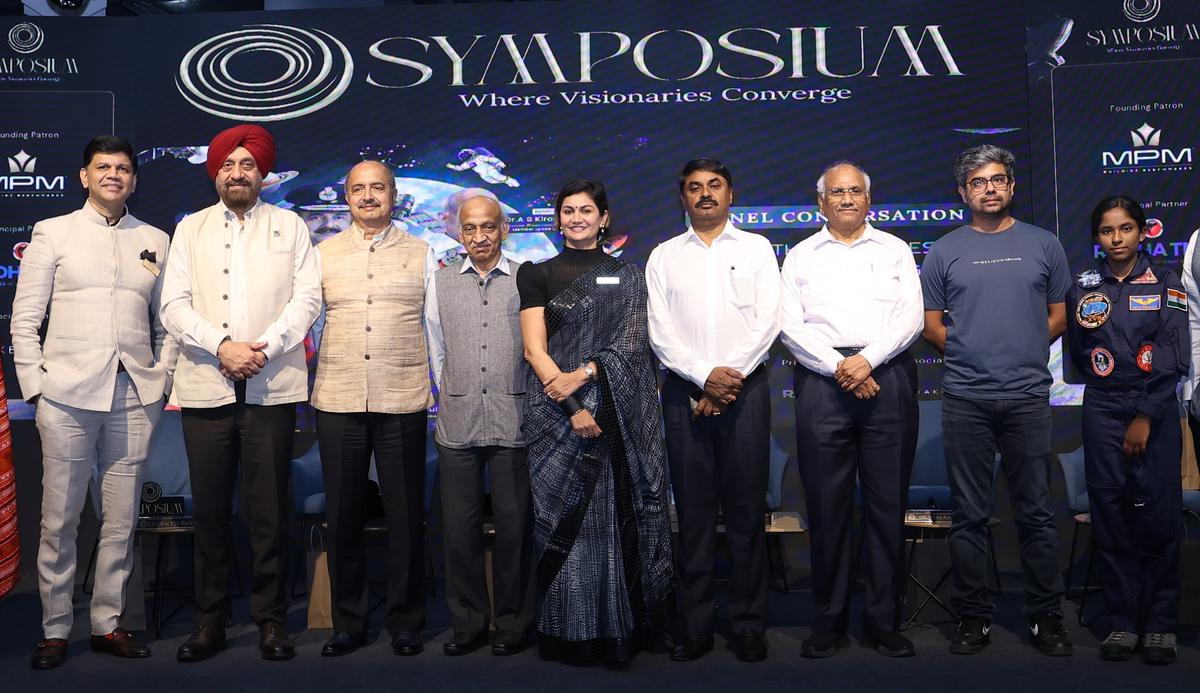
India’s space sector must move decisively from demonstrating technological prowess to building industrial scale — through larger satellite constellations, higher launch frequency, and expanded private participation — former Indian Space Research Organisation (ISRO) Chairman A.S. Kiran Kumar said on Friday at a symposium in Hyderabad.
From Capability to Capacity
Speaking at the third edition of a symposium hosted at T-Hub, Hyderabad, Kiran Kumar addressed an audience of space, defence, and strategic affairs leaders gathered to discuss “The Day the Sky Goes Dark: Warfare in the Age of Satellite Dependence.”
“Our technological achievements are unquestioned. The question now is about building capacity — volume,” Kiran Kumar said. He stressed that private players must step in to deliver that scale, adding: “There is significant scope and an urgent need for greater industry participation.”
DRDO Pivots to Private Sector Partnerships
Former Defence Research and Development Organisation (DRDO) Chairman G. Satheesh Reddy said the organisation is deepening its reliance on industry to develop systems and sub-systems. “We will continue to focus on research and frontier capabilities,” he said.
Reddy also pointed to India’s growing stature as a weapons exporter. “India’s technology standing is ahead of where most people think it is,” he noted — a signal that defence-space convergence is accelerating beyond domestic requirements.
Private Ecosystem Ready, But Starved of Orders
Subba Rao Pavuluri, Chairman and Managing Director of Ananth Technologies, argued that the private space ecosystem is structurally in place but requires sustained procurement and capital infusion to unlock its potential. “The ecosystem is already present. What is required now is steady orders and meaningful capital infusion,” he said.
Pavuluri went further, calling for satellites to be integrated directly into weapon systems rather than treated as standalone specialised assets — a position that reflects growing pressure to operationalise India’s space capabilities for strategic use.
Launch Cadence Identified as Critical Bottleneck
Ronak Kumar Samantray, founder of TakeMe2Space, identified launch frequency as the sector’s most pressing constraint. “We need more rockets. India cannot rely solely on ISRO and SpaceX for deploying India-built satellites. The race belongs to those who can sustain a launch cadence,” he said.
The comment reflects a structural vulnerability: without indigenous, high-frequency launch capability, India’s satellite ambitions remain dependent on foreign infrastructure — a strategic liability that the panel broadly acknowledged.
Policy Reform and Infrastructure Investment Flagged
Across the discussion, panellists converged on three systemic gaps requiring urgent attention:
The panel also included Air Chief Marshal Vivek Ram Chaudhari (Retd.), former Chief of Air Staff, alongside senior officials from Telangana’s administrative and security establishment.
Notably present was Iniya Pragati, a 13-year-old commercial astronaut candidate and India’s youngest analogue astronaut — a symbolic reminder that the sector’s ambitions extend well beyond the current generation of policymakers.